date_range
Sunday 01 Nov 2026


 LOCAL EDITION
close
 LOCAL EDITION


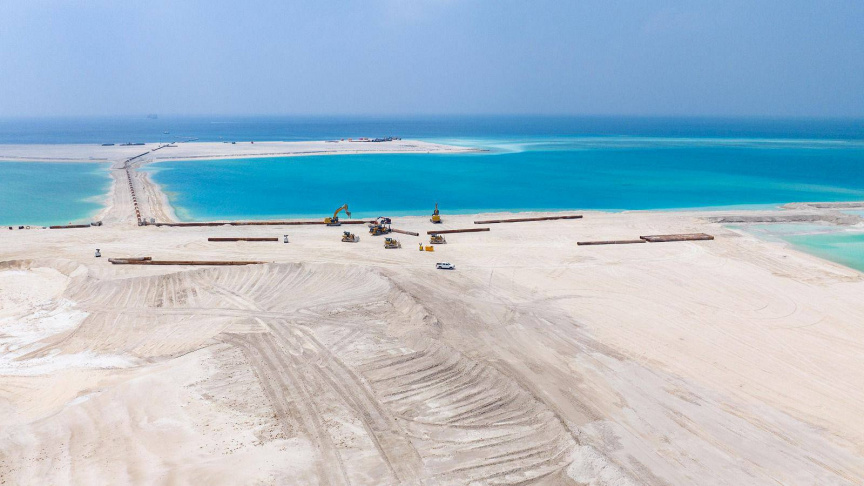
Land reclamation in progress at Rasmale'. (Photo/MACL)
The current value of land in Hulhumale’ is based on over two decades of public investment, says Housing Minister Dr. Abdulla Muthalib, adding that applying the price to calculate the value of the newly reclaimed Rasmale’ which has no bridge, no services and no economic activity is “flawed.”
On September 21, Abu Dhabi-based real estate giant Eagle Hills signed a commercial terms agreement or letter of intent for a mega project to develop a new integrated island destination in Rasmale’, including international hotels and resorts, premium and branded residences, a world-class marina, waterfront promenades, restaurants, shops, leisure and wellness centers.
Muthalib took to Linkedin on Friday to respond to a recent report by a local news outlet which valued the 500 hectares of Rasmale’ land included in the Maldivian government partnership with Eagle Hills at USD 24 billion (approximately MVR 370 billion).
He noted that the USD 24 billion figure is derived from taking Hulhumalé’s current average land price, MVR 7,500 per square foot, and applying it uniformly to every square foot of 500 hectares of newly reclaimed land.
“The flaw in that calculation is obvious. Hulhumalé was not worth MVR 7,500 per square foot when it was first reclaimed,” he wrote.
Reclamation of Hulhumale’ began in 1997, and the first 1,000 residents moved in in 2004.
By 2018, the population of Hulhumale’ increased to over 50,000, coinciding with the opening of the Sinamale’ Bridge, which established a direct road connection between Hulhumale’, Male’, and the Velana International Airport in Hulhule’.

“Hulhumalé’s prices today are the result of more than two decades of public investment: roads, utilities, schools, health care, housing and, from 2018, a connection to the capital,” wrote Muthalib, who was serving as deputy minister for housing, and was in charge of that bridge project at the time.
“Rasmalé has none of that yet. It has no bridge, no services and no economic activity. You cannot take a finished city’s price and apply it to an island that is still being built.”
Muthalib suggested that Thilafushi - reclaimed land in the same region, where industrial plots have been sold at around MVR 1,750 per square foot – would be a fairer benchmark than Hulhumale’.
But he noted that Thilafushi already has businesses operating and a bridge linking it to Malé under construction.
“If anything, it is a generous comparison for Rasmalé as it stands today,” he wrote.
Muthalib also pointed out that not every square foot of land can be sold, describing Hulhumale’ as an example of how a planned city in the greater Male’ region divides its land into housing, commercial use and industry, as well as roads, green spaces, sports and recreation, and schools, mosques and other institutions.

“Planned the same way, Rasmalé’s 500 hectares would have about 239 hectares of housing, commercial and industrial land to sell,” he wrote.
“And it can only be sold once it is serviced.”
He said that before selling a single plot, the state would have to provide water, electricity, sewerage, roads and other municipal services, estimating that setting up these services for a land spanning 500 hectares would cost around USD 1 billion (approximately MVR 15.4 billion), spent up front.
“This is a challenge I understand through firsthand experience. We have reclaimed hundreds of hectares of land, and only a small part of it has been equipped with municipal services today. Faced with the difficulty of borrowing from abroad, we cannot build those services at the speed people want them,” he wrote.
Muthalib took the example of Gulhifalhu where around 230 hectors of land have been reclaimed. He said that developing it needs around USD 400 million of roads and municipal infrastructure, while a powerhouse to serve Gulhifalhu will require additional investment.
“Despite diligent efforts, we have not yet been able to raise that finance — even though the Thilamalé bridge will link Gulhifalhu to Malé,” he wrote.
“If we cannot finance USD 400 million for Gulhifalhu, how would we finance USD 1 billion for 500 hectares of Rasmalé, with no bridge to Malé at all?”
He said that if the state sold the land itself on the same plan, then the best-case scenario, assuming that every plot is sold, is that the state would generate a profit of USD 1.5 billion – much lower than what it stands to gain in revenue share alone from Eagle Hills.
“Even under the most generous realistic assumptions, valuing every private plot at today’s market price yields a figure far lower than the USD 3.1 billion the State is projected to receive from its 10 percent revenue share alone, and that is before accounting for the cost of providing a single public service,” he wrote.

Muthalib said that over the development period, the agreed terms with Eagle Hills are projected to bring the state:
“The 10 percent share alone, approximately USD 3.1 billion (MVR 47.8 billion), is more than the State could raise by selling every housing, commercial and industrial plot itself, before spending a single dollar on services. It does not depend on the State building a city first and then waiting for buyers. And the 4 percent does not end with the development period. It is paid every time a property changes hands, for as long as the development stands,” he said.
“Part of the State’s share also comes first, in the form of homes. The developer is funding 5,000 three-bedroom homes in Hulhumalé up front, before Rasmalé earns a single dollar.”
Muthalib said that while the report describes the lease arrangement as an indirect sale of land, it is the opposite.
“The land is never sold. Eagle Hills sells apartments, villas and other properties on 99-year leases, to buyers approved by the Government. When a property changes hands, the Government must approve the new buyer; it then cancels the old lease and issues a new one, for 4 percent of the value,” he wrote.
“In a sale, the State steps away. As opposed to this, here, the State is a party to every transaction, for as long as the development exists. The land’s value returns to the State not once, a century from now, but every time a property changes hands.”
Muthalib said that what the state collects is only part of the story.

He noted that the partnership is projected to bring about USD 22 billion in net foreign investment over its life and to create more than 60,000 direct and indirect jobs. At maturity, it is expected to draw about a million visitors a year and generate over USD 2 billion a year in tourism revenue.
He said that many of those jobs are ones Maldivians can take while living with their families, in a city where other 500 hectares will be built for local population, rather than on a resort island far from home.
He said that building and running the hotels, homes and shops will bring work to Maldivian contractors, suppliers, transport operators and service businesses.
“That activity is what turns reclaimed land into a living city. It is also what our economy needs now: more revenue for the State, less pressure on our debt and our foreign currency, and growth that directly reaches Maldivian households,” he wrote.