date_range
Tuesday 29 Sep 2026


 LOCAL EDITION
close
 LOCAL EDITION


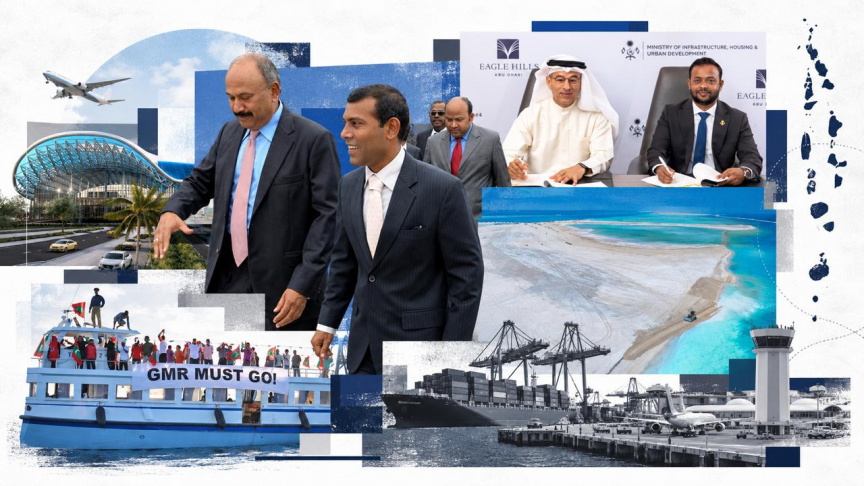
A new USD 20 billion project by a Abu Dhabi-based developer has sparked controversy in the Maldives. (Sun Graphics/Ahmed Saail Ali)
This is the story of a close friend who inherited a plot of land from a prime location in Male’ years back. A plot where he could build a spacious 10-story building. He inherited the land in his 30s, but remains unable to build on it, as he counts his 50s. He is unable to build it because there’s no way for him to get it done without compromising exactly how he wants to get it done. He lacks the financial capacity to get it done on his own. He has the option of taking out a bank loan and paying it off by renting off the property, but does not want to take on a debt. The other option available to him is contractor financing. But he does not find having floors of his own property owned for years by someone else appealing either. And so, the plot of land he owns in Male’ remains empty, useless to him as he approaches his 60s.
This story reflects a wider problem in this country.
Every time the government proposes to hand over the Maldives' major assets, lands, or major infrastructure development projects to foreign investors, it sparks the same political debate. Questions of "why is our country being sold off?" This discourse is nothing new.
The same debate emerged back in 2010, when the Male’ international airport was handed over to India's GMR and Malaysia Airports. And when the government reduced its stakes in Dhiraagu and Male’ Water and Sewerage Company (MWSC) and sold shares to foreign companies. This debate is back again in full force, following the announcement of a mega waterfront and marina project in Rasmale’ by Abu Dhabi’s Eagle Hills. But there’s a far more important question. Is mere state ownership over capital assets, by itself, of the most benefit to Maldivian citizens? And, can a country with little capital, huge infrastructure development needs and daunting debt, develop its airports, seaports and utility companies on its own?

The GMR case is a clear example of how an economic policy turned political. Back in 2010, then-President Mohamed Nasheed’s administration handed over the country’s main airport to GMR for a period of 25 years after a competitive bidding process overseen by the International Finance Corporation. The government received USD 78 million under the deal, with plans made to invest millions of dollars more in the airport. The World Bank later described this as the Maldives’ first major Public-Private Partnership (PPP), projecting the total investment to reach USD 400 million. However, the disagreements that arose over the airport development charge and other matters pertaining to the agreement quickly turned political, and the agreement was terminated in 2012, after the fall of Nasheed’s administration. The termination of the deal went into international arbitration, ending in the Maldives having to pay GMR USD 270 million in compensation. The case demonstrates the high economic cost when infrastructure projects spark political disagreement. What foreign investors need is the guarantee that an agreement signed by one administration will be honored by successive administrations.
Now lets look at Dhiraagu, a company established in 1988 via a partnership between the Maldivian government and
Looking at the example of Dhiraagu, that company was created in 1988 jointly by the government and UK-based Cable & Wireless. In 2009, the government sold seven percent of shares in Dhiraagu to Cable & Wireless for USD 40 million, reducing the government's share to 48 percent. And in 2011, the government sold more of its shares to the public. Today, 52 percent of Dhiraagu’s shares are held by Bahrain's Beyon, while the government owns 41.8 percent, and the public holds the remaining 6.2 percent. Even under foreign ownership, Dhiraagu operates as a Maldivian company. However, there has been a shift in this policy, with President Dr. Mohamed Muizzu recently announcing plans to boost government share in Dhiraagu to 51 percent, and to also buy the 20 percent stake at MWSC currently held by Japan’s Hitachi. This shift begs the question: why is foreign ownership at a strategic company good one moment, but bad the next? Is this based on politics alone? Or is this based on national security concerns, market competition and financial gain? Does foreign ownership of stakes mean a total loss of government control? Both Dhiraagu and MWSC, with its shares owned by foreign companies, are among the best managed companies that the state owns stakes in.
The current system based on which state-owned enterprises or SOEs are run poses one of the greatest challenges for the Maldivian economy. From electricity to water to airports to seaports to construction, transport, housing and even trade – the government has created companies to run it all. While some of these companies are profitable, others run at a huge loss. Reports released by the Privatization and Corporatization Board (PCB) show SOEs are carrying billions of Rufiyaa in losses. The Auditor General’s Office has repeatedly raised the alarm regarding the heavy burden on the state to cover the losses. The World Bank has been urging the Maldivian government to reform SOEs and increase the private sector participation to stabilize the economy as far back as 2024. When a government owns so many companies, they become weapons for political leverage. The people who run these companies are politicians with little to zero experience in running a business. These companies control the job market, contracts, and major budgets. As a result, commercial decisions by these companies are perhaps guided more by political need, and less by profit and efficiency.
Its not just in the Maldives alone that major projects that governments alone cannot finance are run through public-private partnerships or PPP. The airports in India’s Delhi and Mumbai were developed by a consortium including GMR, Fraport, and Malaysia Airports. 30 percent of shares in Salalah Port – Oman’s largest port – are held by Netherlands-based APM Terminals, with the remaining shares held by the Oman government and pension funds. This USD 800 million port is now a key hub that connects Asia and Europe. The Maldives has similar opportunities open to it. According to the Maldives Investment Promotion Agency, more than 70,000 cargo ships travel through the Maldives region each year. The Maldivian government is currently developing an international port in Thilafushi with a 600-meter container quay and a capacity of 280,000 TEUs. And efforts are also underway to establish a transshipment port and bunkering service in Laamu Atoll. However, developing a good port requires huge capital, technology and connections with shipping lines. So, if this is too massive an endeavor for the government alone, why not get it down by forming joint ventures with foreign companies? The Maldives continues to look on as its neighbors utilize their seaports. The government hasn’t been able to execute major projects on its own.
This same question arises regarding the Maldives' airports. The country has the Hanimaadhoo International Airport in its north and the Addu International Airport is its south. But the mere fact that it has these strategically located airports is of little economic benefit. An airport needs airlines, passengers, cargo, and strong management. The government can own the runway and terminal, but it must consider handing over the management of airports on a concessional basis to foreign operators if it cannot run these places on a commercial basis.

And now, the same questions arise regarding a new mega project - described by the Maldives government as one of the most ambitious development initiatives in the country’s history. On September 21, Abdu Dhabi-based Eagle Hills signed a commercial terms agreement for a mega project to develop a new integrated island destination in Rasmale’, including international hotels and resorts, premium and branded residences, a world-class marina, waterfront promenades, restaurants, shops, leisure and wellness centers. Its not wrong for critics to scrutinize the price of the land which is being leased for 99 years, the environmental impact and the transparency surrounding the deal. The solution to this is to publicize the agreements. To disclose how the land was valued, the revenue the government will generate, and the responsibilities of the investor. Leasing a land for 50 or 99 years does not compromise a country’s sovereignty. Neither does a foreign company owning a minority stake at a state utility company. What’s important is to strengthen the legal framework and regulatory system.
What the Maldives needs is a strong framework on the management of its strategic assets. Airports and seaports that can be run on commercial basis can be opened for foreign investors through competitive bidding, while keeping assets linked to national security under state control. It can be changed so that the government regulates and private parties operate. Foreign investors will have no confidence in the Maldives is agreements are voided with every change in administration.
The World Bank advises the Maldives to reduce state expenditure and increase private sector participation in order to minimize the country’s financial vulnerability. The mere fact that the Maldives is situated in an Indian Ocean location of strategic importance is of no use. The country needs investment and expertise to turn this into economic gain.
Therefore, what’s more important than the political question of “is the country being sold off?” is determining the assets the state must maintain control over, what it needs to regulate, and what projects it will leave for private parties. Unutilized assets may not protect this country’s wealth. Sometimes, the biggest danger is to keep control over an asset or great potential that the government has neither the funds nor expertise to develop.
So far, the Maldives is walking on the same path as that of my friend; owning a valuable asset, but unable to utilize it as time runs out.