date_range
Thursday 24 Sep 2026


 LOCAL EDITION
close
 LOCAL EDITION


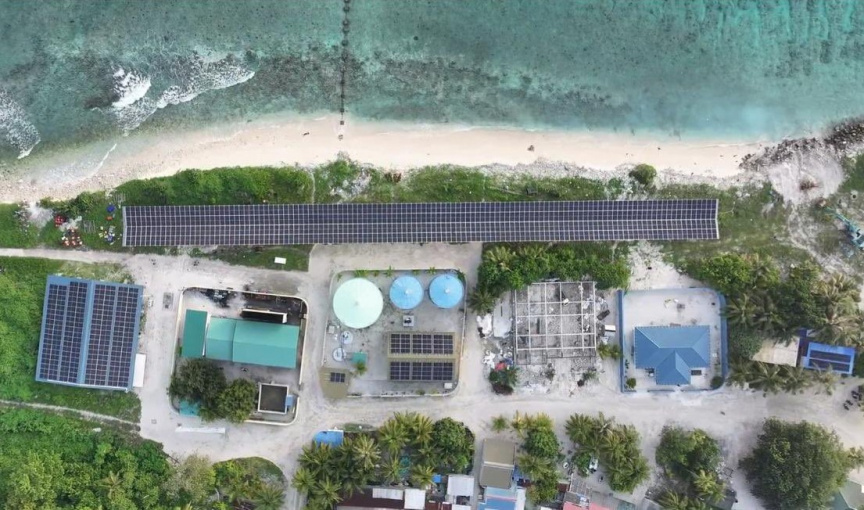
A solar-diesel-battery hybrid system installed in R. Innamaadhoo. (Photo/Environment Ministry)
Environment Minister Ali Shareef says that the rollout of solar power initiatives by the incumbent administration has boosted the Maldives’ renewable energy capacity from 53 megawatts to 126 megawatts, saving around 3.1 million liters of diesel annually.
At a press briefing on Thursday morning, Ali Shareef said that the administration has rolled out solar hybrid systems featuring 6.36 megawatts of solar photovoltaic capacity and 10 megawatt-hours of battery energy storage across 23 islands in the Baa and Raa atolls.
He said that the initiatives have boosted the country’s installed renewable energy capacity from 53 megawatts to 126 megawatts.
“As these systems are rolled out, it will save the use of around 3.1 million liters of diesel annually. It also reduces the release of 8,400 tonnes of carbon dioxide annually,” he told reporters at the President’s Office.

Ali Shareef said that in Raa atoll islands of Rasmaadhoo, Vaadhoo and Kinolhas, and Baa atoll island of Kudarikilu, powerhouses are shut down for four-six hours daily, and the islands are powered with solar energy.
He said that this has significantly reduced fuel usage at the islands.
The Maldives imports 100 percent of its fuel, primarily diesel and petrol from the Middle East.
Information released by the Environment Ministry back in May shows the Middle East conflict has driven the cost of the country’s monthly fuel imports from USD 50 million to USD 116 million – marking an increase of 132 percent.
The country needs 8,000 barrels of diesel daily or around 2.9 million barrels yearly to produce electricity.
The small island nation spent around MVR 10 million on fuel imports last year alone.
President Dr. Mohamed Muizzu has announced plans to generate 33 percent of its electricity from renewable energy sources by 2028.