date_range
Sunday 20 Sep 2026


 LOCAL EDITION
close
 LOCAL EDITION


"Who is the People's Majlis? [Former President Maumoon Abdul Gayoom] Maumoon. Who is the Supreme Court? Maumoon. Who is the President? Maumoon. Who is Maumoon? Maumoon."
This was a famous rhetorical device used by Reeko Moosa Manik, a prominent leader in the opposition MDP at the time, to describe the extent to which President Maumoon had consolidated power during his thirty-year rule. One of the primary arguments the opposition used to convince the public of the necessity for change was the danger of vesting all powers in a single individual.
More than 18 years have passed since then. With democracy, the Maldives has indeed seen positive changes—increased freedom of speech, more direct benefits to the citizens, and a pace of development many times faster than before. The power of the people has grown. But the question remains: what happened to the dream of the separation of powers that was promised to Maldivians?
In the political history of the Maldives, following the reform efforts that began in 2004, one of the greatest aspirations of the people was a fully democratic system where the three branches of state were separated. To ensure the mistakes of Maumoon’s long rule—where power was held in a single fist—were not repeated, a new Constitution was ratified in 2008. A core objective of this Constitution was to establish a system of checks and balances between the Executive, the Legislature, and the Judiciary.
However, after 18 years spent in the name of democracy, a different picture is emerging. While the Constitution mandates the separation of powers, the bitter reality Maldivians must accept today is that it is not being implemented in practice. The philosophy of separated powers exists only on paper. Billions are spent on it, yet the result remains zero.

Five presidents, and a culture of consolidating power
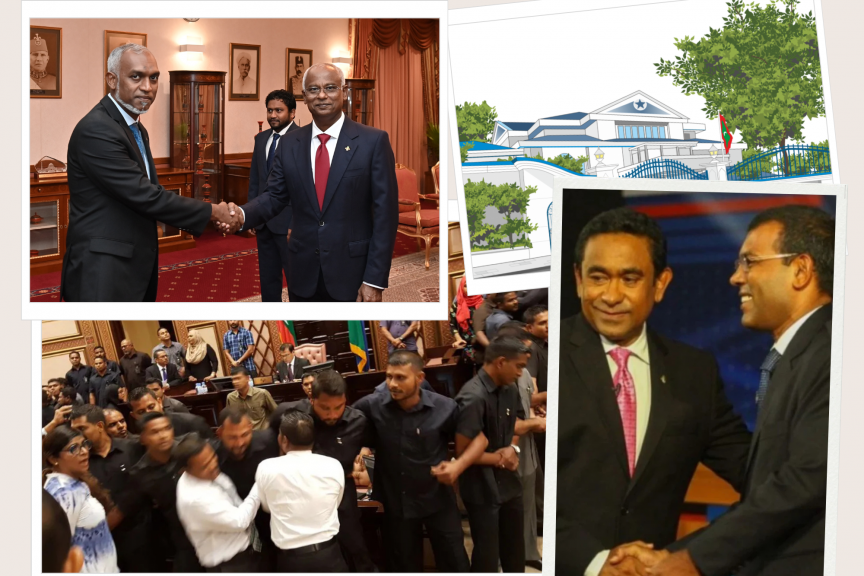
Five presidents have held office since the new Constitution came into effect: President Mohamed Nasheed, President Dr. Mohamed Waheed Hassan Manik, President Abdulla Yameen Abdul Gayoom, President Ibrahim Mohamed Solih, and the incumbent President, Dr. Mohamed Muizzu. A common trait among all five upon taking office has been the effort to further expand executive authority. Every president, after coming to power, prioritized securing a majority in the People's Majlis. And except for Nasheed, they all succeeded. Once that was achieved, the focus shifted to influencing the judiciary. This pattern has been clearly visible across all five administrations.
During Nasheed’s presidency, the “locking” of the Supreme Court and the intense "confrontations" between the Majlis and the government showed that even the first democratic president desired total control. The influence exerted over the Supreme Court and the Majlis during Yameen’s tenure is another stark example. Under Solih, with a supermajority in the Majlis, the parliament became a place that rubber-stamped laws exactly as the government desired.
When President Muizzu took office, he announced that influence over the judiciary would cease immediately. However, the opposite occurred. A prime example is the treatment of three Supreme Court justices as soon as it was decided that a case involving government interests could be heard. Despite their high level of education and experience, these justices of the highest court were treated poorly.
After the public gave the ruling party, PNC, a supermajority, the Constitution was amended within six hours to effectively "bind the hands and feet" of the members. The power to strip a member of their seat if they displease the President was taken into his hands. It can be argued that the current PNC-led Majlis is the one where the individual power of members has been most diminished and weakened. A party can now strip a member of their seat whenever they wish.
Consequently, the concept of separation of powers guaranteed by the Constitution has been completely distorted. Instead of holding the government accountable through the Majlis, we see a parliament that defends the government and does exactly what it is told, how it is told. Moreover, because of the composition of the Judicial Service Commission (JSC), the independence of the judiciary is always in question. No government has sought to reform this—perhaps because doing so would mean they could no longer influence court cases.
The cost of democracy
To run this democratic system, billions of Rufiyaa from the taxpayers are spent every year. When President Maumoon’s rule ended in 2008, the total state budget was approximately MVR 11 billion. However, the budget passed for 2024 reached MVR 49.8 billion, and with the supplementary budget, that figure neared MVR 55 billion. The budgets for 2025 and 2026 remain at similarly high levels. A large portion of this expenditure goes toward non-revenue-generating sectors: government administration, the People's Majlis, the judiciary, and independent institutions.
Hundreds of millions are spent annually to run institutions like the Anti-Corruption Commission (ACC), the Elections Commission, and the Human Rights Commission, yet they fail to produce adequate results. For instance, budgets for independent institutions were recently increased by millions. Yet, despite this massive spending, the independence of these institutions is not secured, meaning there is little difference in the outcome compared to the old system. These institutions often dance to the tune of whoever is President. They are independent in name only; in practice, they are ineffective.
Since the power to determine the budgets of these "independent" institutions lies with the Ministry of Finance and a government-controlled Majlis, they lack true financial independence. Even though billions are spent, it is common for major corruption cases to go uninvestigated and for justice to be delayed. A look at the state of the ACC, which spends about MVR 50 million annually, makes this clear.
The public has gained little benefit from a democracy that costs billions.
The damage from consolidating power
The damage caused to the nation by consolidating power is immense. Firstly, it prevents those who embezzle state property and funds from being held accountable. The massive MMPRC scandal, the ventilator corruption, and the thefts occurring through Fenaka and other state-owned enterprises are prime examples. Because government influence extends to independent institutions and the judiciary, politically powerful individuals are able to stay above the law. They live in freedom after committing massive thefts of public funds and gaining illicit wealth.
Public trust in the institutions created to protect their rights is eroding. It has become common in the Maldives for laws to be changed and heads of institutions to be removed just to achieve the goals of the ruling administration. This hinders national development, erodes the trust of foreign investors, and causes the country to slide backward economically. Real development cannot occur where the rule of law is absent.
What is the solution? Global examples
To establish a true system of separated powers, the Maldives must learn from developed democracies. For example, in countries like the United States, the legislature and the executive are two completely separate powers. The President’s ability to influence the legislature is very limited. In the United Kingdom, despite having a parliamentary system, the independence of the judiciary is fully guaranteed.
To achieve this in the Maldives, the first step is to appoint sincere individuals and grant financial independence to state institutions. A specific percentage of the state budget should be mandated by law to go directly to these institutions. Secondly, the composition of the JSC must be reformed to remove the Attorney General and members of the Majlis. The commission should be restructured to include technical experts rather than politicians. Additionally, the influence over members of the People's Majlis must be reduced, ending the era where the Majlis acts as a mere branch of the government.

While Maldivians are spending billions in the name of democracy, it is unacceptable that the public does not receive the true benefits of a system with separated powers. If the words written in the Constitution are not put into practice and the ruling party keeps all power in its grip, this is a democracy in name only.
If the People’s Majlis does not take steps today to bring about the legal and systemic changes needed to ensure the independence of institutions, the next generation will inherit a failed system. Before passing the next budget, the Majlis is obligated to create a legal framework that ensures the financial independence of these institutions.
Spending billions for a specific purpose will not yield results if that purpose is never achieved. This has failed so far because of a lack of sincerity from the top leadership. In reality, all five presidents have preferred not to govern with separated powers. They simply wish to rule like monarchs. The bitter result is that despite spending billions to separate powers, they remain consolidated. Over the past 18 years, Maldivians have become a people who spent billions to separate powers, only to end up consolidating them.