date_range
Wednesday 22 Jul 2026


 LOCAL EDITION
close
 LOCAL EDITION


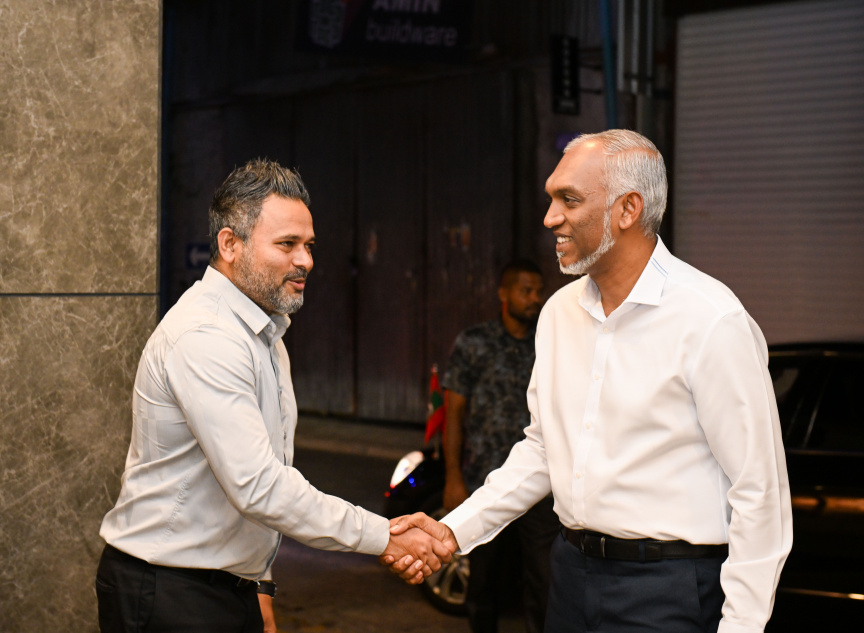
President Dr. Mohamed Muizzu (R) and Fisheries Minister Ahmed Shiyam (L): Shiyam states frequent elections disrupts peace within the society. (Photo/President's Office)
Ahmed Shiyam, Fisheries Minister and Deputy Leader of the ruling People's National Congress (PNC), said on Sunday that the Maldives’ frequent elections place a heavy financial strain on citizens and foster a political atmosphere that distracts from social welfare and government development efforts while also disturbing peace and stability within the community.
Addressing a PNC press conference about a proposed referendum to assess public opinion on aligning the country’s two main national elections, Shiyam stressed that the overall financial burden of repeated elections on the public is considerable.
According to the Minister, an individual candidate spends about MVR 1.5 million on average. He noted that in the 2009 Parliamentary Elections, where 455 candidates contested, total spending was estimated at MVR 782 million. He further projected that if candidates in the 2024 elections each spent around MVR 3 million to win a seat, total expenses could rise to roughly MVR 1.1 billion.
"The political turbulence created within communities persists from one election to the next. We have observed that tensions within families and among friends go unresolved, and the resulting friction in small communities significantly hinders social activities and the development projects initiated by the government," Shiyam remarked.
He added, "There is a direct link between the frequency of elections and public order; stability is often compromised. Furthermore, as parties prepare for elections, some members of the opposition tend to portray the government’s vision in a negative light."
At the same briefing, Ibrahim Falah, Parliamentary Group Leader, said that repeated elections consume valuable time needed for governance and the implementation of development projects.
On February 10, the ruling PNC used its supermajority in the Parliament to pass constitutional amendments backed by the government to hold future presidential elections and parliamentary elections on the same day.
On February 16, President Dr. Mohamed Muizzu decreed that a public referendum on this – as required by law on such matters – would be held on April 4 – the same day as the local council elections.
The government has argued that the main goal of merging the elections is to cut state spending.
Under the current system, voters go to polls twice within around six months every five years, electing the president in September and members of Parliament in April.
But the constitutional amendments passed by the Parliament proposes merging the two elections, and bringing forward the start of the parliamentary term from May to December 1 to get this done.
This change will shorten the five-year term of the current parliamentary assembly, sworn in on May 28, 2024, by around six months.
The first combined poll would take place in 2028.
President Muizzu first announced plans introduce constitutional amendments to combine the two major elections back in 2024. He promoted it as a cost-cutting measure that will save around MVR 120 million in expenses.
However, the opposition is largely opposed to such a move, describing it as an attempt by the PNC to hold on to power