date_range
Sunday 20 Sep 2026


 LOCAL EDITION
close
 LOCAL EDITION


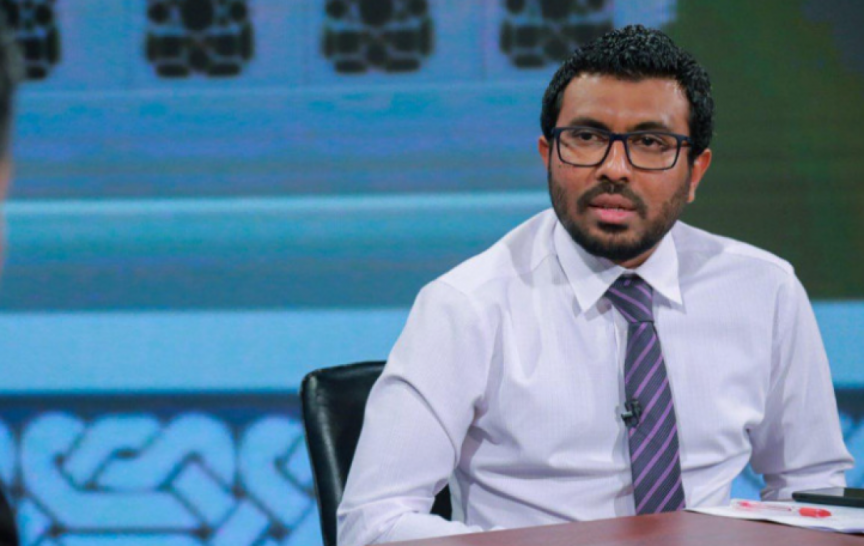
Ahmd Saruvash Adam. (Photo/PSM)
The MVR 2.4 billion transaction planned by the Maldives Pension Administration Office (MPAO) will release excess Rufiyaa into circulation and raise inflation, says Ahmed Saruvash Adam, who resigned from the MPAO’s board in protest of the proposal last year, as he also called out the Maldives Monetary Authority (MMA) for failing to properly explain why such a move is necessary at such a critical time for the Maldivian economy.
According to MPAO, the Finance Ministry proposed investing in an MVR 2.4 billion treasury bond with dual currency – MVR and USD – returns.
The MPAO says that based on the liquidity of the pension fund, the proposed method of securing funding for the investment is by raising money by selling in the secondary market MVR 2.4 billion in treasury bonds invested in by the Maldives Retirement Pension Scheme.
The MPAO’s board received the proposal back in October last year. Saruvash, who previously served as Chief Financial Budget Executive at the Finance Ministry, resigned from MPAO’s board soon after.
Saruvash told Sun that as he mentioned in his resignation letter, the transaction planned by MPAO would be fine if it was a market transaction.
The issue lies in the involvement of the MMA, which no longer makes this a market transaction, he said.
Saruvash said that when the MMA releases Rufiyaa into circulation, it increases the supply of Rufiyaa, and is therefore taken as money printing.
He warned that this puts the Maldivian economy in greater jeopardy, and the transaction cannot be allowed to proceed by dismissing this risk by justifying this is being done through the secondary market.
Saruvash said that the MPAO has many factors it can show as justification to proceed with the transaction.
The things they mentioned in Tuesday’s press statement are not wrong, he said.
“This includes getting returns in dollars. The portfolio in structured to obtain nominal returns. Therefore, looking at this from that angle, it’s not an issue. But because the investor, the secondary market is the MMA, this creates certain risks, which in turn creates risks that the value of the pension portfolio may decline,” he said.

‘Maldives needs a contractionary monetary policy’
Saruvash said that what the Maldivian economy needs right now is a contractionary monetary policy, given the need to mop-up the excess liquidity.
In June last year, the MMA commenced Open Market Operations to absorb the excess MVR 7 billion in circulation as a result of money printing during the Covid-19 pandemic.
Its current policy marks a U-turn.
Saruvash said that the MMA has not been able to explain the reason why it dropped the previous contractionary monetary policy and decided to adopt an expansionary one that will create more excess Rufiyaa in the economy.
“This is not the best policy at this time. We still need to maintain a contractionary policy,” he said.
Saruvash said that the current economic situation is not similar to the one the country faced during the Covid-19 pandemic. And there’s currently no need to increase the money supply given the economic development.
He warned that increasing the money supply carries risks of inflation.
Saruvash said that he finds it hard to get behind such a move when the MMA hasn’t explained how it plans to mitigate the inflation risks or explain why the transaction is necessary at this time.
Saruvash said that the motivation behind the transaction is to raise money for budgetary support.
He believes the government should be looking at ways to cut costs instead.
“Therefore, they need to do everything they can to bring down the budget financing requirement as much as possible. They should not be exploring other options before getting this done first. The second thing is, there needs to be coordination between the monetary policy and the fiscal policy,” he said.
Saruvash had been the first to resign from the MPAO in protest over the MVR 2.4 billion transaction proposal, followed by the office’s Chief Financial Officer Hawwa Fajwa, and chairperson Dr. Ahmed Inaz.