date_range
Friday 09 Oct 2026


 LOCAL EDITION
close
 LOCAL EDITION


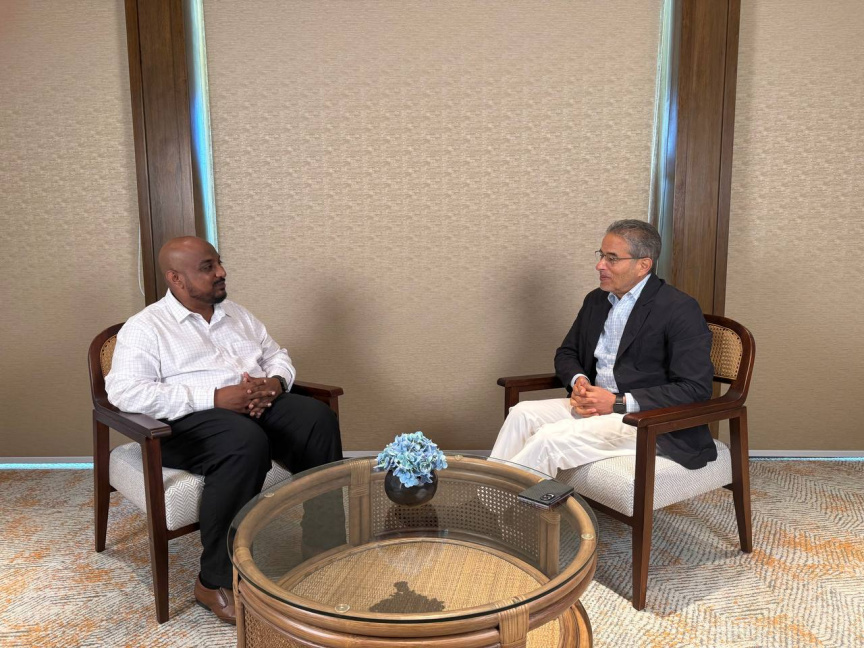
Sun Online’s managing editor Ahmed Saail Ali (L) interviews Eagle Hills’ founder and chairman Mohamed Alabbar (R) on October 7, 2026. (Sun Photo)
Mohamed Alabbar—who has spearheaded mega-projects such as Dubai’s Burj Khalifa, the tallest building in the world—has now turned his attention to the Maldives. As Chairman of Abu Dhabi-based real estate company Eagle Hills, the project he is leading in Rasmalé is not simply about constructing buildings. While numerous questions have emerged regarding the project, I had the opportunity to interview him today, during which many of these uncertainties were addressed.
He describes the Rasmalé project as being comparable to building small cities. Developing a complete destination—including roads, schools, parks, hotels, and commercial spaces—is an area in which he has extensive expertise. Over the past three decades, he has undertaken similar projects in approximately 20 countries. These include the Belgrade Waterfront in Serbia, Durrës Yachts & Marina in Albania, as well as major developments in Bahrain and Egypt.
On September 21st, the Maldivian government and Eagle Hills signed a commercial terms agreement for the development of "Maldives Waterfront and Marina" in Rasmalé. Under the agreement, a vast area is set to be developed. In an exclusive interview with Sun today, Alabbar stated that the project will bring thousands of jobs, housing opportunities, and new tourism prospects to the Maldives, while also generating billions of dollars in tax revenue.

One of the most significant components of this mega-project is the construction of 5,000 housing units in Hulhumalé. Alabbar emphasized that this housing development will represent Eagle Hills’ initial investment. With an estimated cost of approximately USD 500 million, the company will initially finance the project itself and recover the investment only after the broader Rasmalé development has been fully completed. The government has also identified this as one of the key benefits of the agreement.
Responding to questions about how such a large-scale project will be financed, Alabbar stated that funding will be secured through Eagle Hills’ equity, bank loans, and revenue generated from property sales. He explained that the company must first invest its own funds before obtaining bank financing. Although the design and contracting stage would typically take approximately 12 months, he said efforts are underway to reduce this timeframe, with physical construction expected to commence in about a year.
Emphasizing the benefits that the development of Rasmalé’s 500-hectare area could bring to the Maldives, Alabbar stated that the government is expected to receive nearly USD 20 billion in tax revenue over the lifetime of the project. Drawing on examples from developments undertaken in countries such as Egypt and Serbia, he expects Rasmalé to attract at least one million additional tourists to the Maldives. In terms of employment, he estimated that approximately 40,000 jobs will be created during the construction phase, followed by 15,000 to 18,000 permanent jobs once the development becomes operational.
Alabbar also identified the inflow of foreign currency into the Maldivian financial system as a crucial benefit of the project. Rather than transferring foreign currency generated from apartment sales to Abu Dhabi, he stated that these funds will remain within Maldivian banks, thereby creating a positive impact on the country’s economy.
Alabbar also addressed public concerns over potential national security risks associated with granting such a large area to a foreign company. He stated that Eagle Hills operates according to the principle of respecting the laws of the host country and will not proceed if the public does not support the development. If the applicable regulations provide for a 99-year land lease, those regulations must be respected, he said, adding that anyone unwilling to accept such rules should not engage in business. He further acknowledged that public concerns must be addressed honestly. He explained that the detailed agreements have not yet been made public because they are still being finalized, but all relevant information will be disclosed once the agreements are complete.
Although he did not provide a direct response regarding what would happen if Eagle Hills failed to fulfill its obligations under the agreement, Alabbar emphasized that the final agreement must safeguard the rights of both parties. Agreements should not be structured overwhelmingly in favor of one side, and developers must act responsibly. He reiterated that the company has committed to investing USD 500 million in the housing project before generating any profits. He noted that when conducting business, consideration must be given to the extent of the benefits provided to the public, emphasizing that seeking to retain all profits for oneself is not his approach.

Alabbar’s objective is to finalize the detailed agreement for the Rasmalé project as soon as possible. As one of the largest development projects ever announced in the Maldives, its success will depend not only on the blueprints, but also on how the final agreement is structured, how financing is secured, and how effectively the project is implemented in the years ahead. The interview with Alabbar provided a measure of assurance on these matters.