date_range
Monday 21 Sep 2026


 LOCAL EDITION
close
 LOCAL EDITION


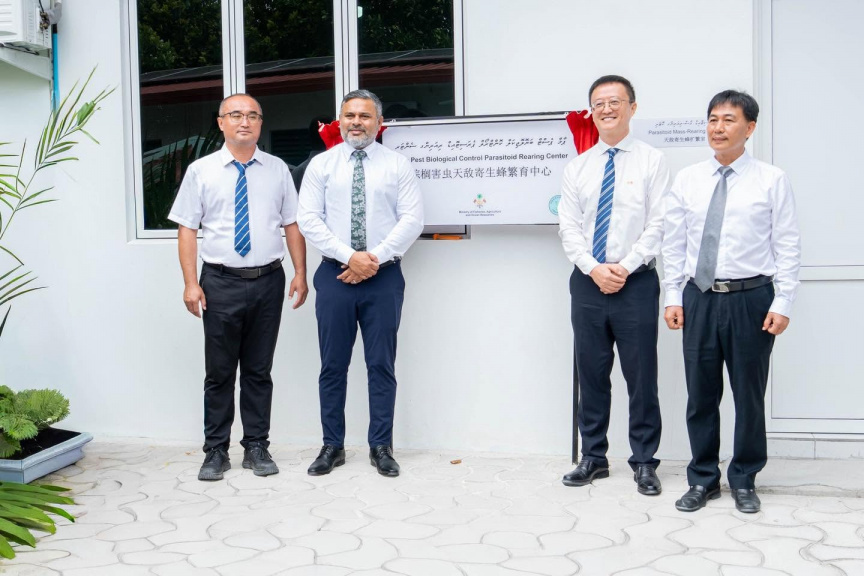
From the inauguration of ‘Palm Pest Biological Control Parasitoid Rearing Center,’ established breed environmentally beneficial insects that naturally combat pests affecting coconut palms. (Photo/Agriculture Ministry)
The ‘Palm Pest Biological Control Parasitoid Rearing Center,’ established to breed environmentally beneficial insects that naturally combat pests affecting coconut palms, was officially inaugurated on Thursday,
The facility, located at the Hanimaadhoo Agriculture Center, was jointly inaugurated by the Minister of Fisheries, Agriculture and Ocean Resources Ahmed Shiyam, and the Chinese Ambassador to the Maldives, Kong Xianhua.
The Palm Pest Biological Control Parasitoid Rearing Center is a key component of the "Maldives Coconut Tree Pest Control Assistance Project," a collaborative initiative between the Maldives’ Ministry of Fisheries, Agriculture and Ocean Resources and the Chinese government. The formal agreement for this project was signed between the Ministry and China’s Ministry of Commerce on July 14, 2025.

The primary objective of this project is to identify diseases and pests affecting the nation’s coconut palms and establish a sustainable management system. This involves employing eco-friendly methods, specifically by breeding beneficial insects (biological control agents) that prey on palm pests and releasing them into infested areas. The Ministry stated that the new center has the capacity to produce 100,000 parasitoids daily.
In conjunction with the inauguration, a training program focused on managing diseases and pests affecting coconut palms was conducted at the Hanimaadhoo Agriculture Center from Sunday through today. Minister Shiyam presided over the closing ceremony, presenting certificates to the participants.
According to the Ministry, the program saw participation from 50 individuals, including farmers, representatives from local councils, and personnel from private agricultural companies. The training, which included both theoretical and practical components, was conducted in English by technical experts from the Chinese Academy of Tropical Agricultural Sciences.

The curriculum focused on integrated pest management techniques using natural biological controls and strategies for managing plant diseases. Participants were also given a tour of the Hanimaadhoo Agriculture Center's laboratory to observe the technical processes firsthand.
The Ministry highlighted that this training marks a significant milestone in expanding the use of modern pest control systems in the Maldives. It further noted that the project is expected to bring substantial advancements to the agricultural sector, particularly in the protection and preservation of the country’s coconut palm population.