date_range
Tuesday 25 Aug 2026


 LOCAL EDITION
close
 LOCAL EDITION


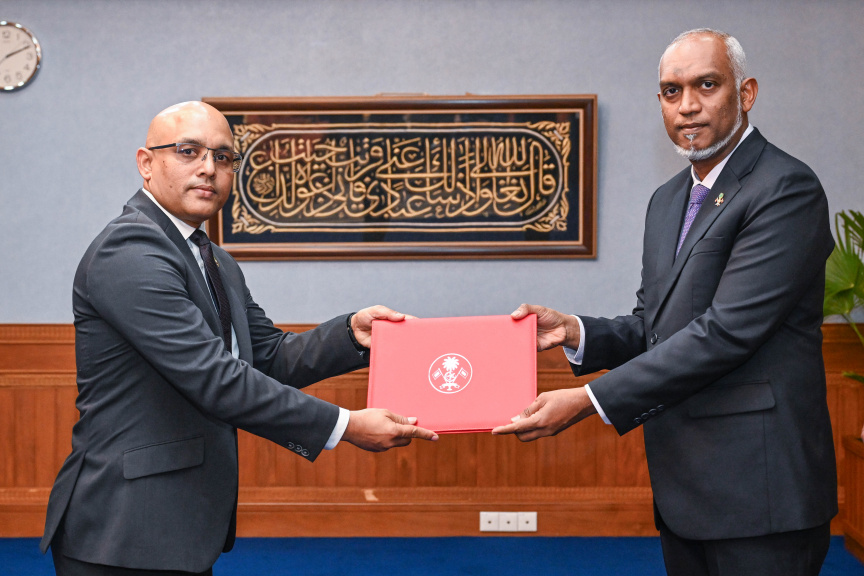
Finance Minister Hassan Zareer (L) and President Dr. Mohamed Muizzu: Recurrent expenses such as salaries tops state expenses at 87%, capital expenses at 13%. (Photo/President's Office)
Recurrent expenditure, which covers the government's day-to-day operational costs, accounts for 87 percent of the government’s total expenditure so far this year.
As such, only 13 percent of total expenditure was allocated to capital spending, which funds long-term development and infrastructure projects.
As of early July, total state expenditure stood at MVR 23,380.0 million, exceeding total state revenue and grants, which amounted to MVR 22,404.1 million.
According to the Finance Ministry’s latest Weekly Fiscal Developments report, recurrent expenditure had reached MVR 20,333.2 million by July 2. This represents a significant increase from the MVR 16,890.0 million recorded during the same period last year.
Since the current administration assumed office, one of the most persistent criticisms has centred on the high number of political appointments. The government has faced scrutiny over the recruitment of individuals to positions widely viewed as unnecessary or for which they are perceived to lack the required qualifications. As a result, the national wage bill has continued to rise annually.
Administrative and operational expenses accounted for the largest share of recurrent spending. A total of MVR 12,275.6 million was allocated to the operation of government offices, welfare programs, subsidies, and public service delivery. Salaries, wages, and pensions amounted to MVR 7,987.1 million, while losses and write-offs totalled at MVR 70.5 million, a sharp increase from the MVR 11.9 million recorded during the corresponding period last year.
Despite the increase in recurrent expenditure, only MVR 3,046.8 million has been spent on capital projects, representing a relatively small proportion of the MVR 9,284.4 million capital budget approved for this year. The breakdown of capital expenditure is as follows:

Infrastructure Development: MVR 1,740.1 million allocated to projects including road construction, harbour development, bridge construction, and airport expansion.
Land and Buildings: MVR 965.3 million allocated for the construction and acquisition of government buildings and other public facilities.
Capital Equipment: MVR 324.7 million allocated for the procurement of heavy machinery, vehicles, and technical equipment.
Development Projects: MVR 16.7 million allocated to specialized development programs.
Financial reports indicate that allocating 87 percent of state expenditure to recurrent costs presents a significant macroeconomic challenge. While tax revenue generated MVR 17,251.7 million of total state income, nearly all of this revenue has been absorbed by day-to-day government operations, leaving limited domestic resources available to finance infrastructure development.
Economists have warned that sustained reliance on recurrent expenditure could increase the risk of a debt trap for a developing economy. When domestic revenue is largely consumed by operational expenses, governments are often compelled to depend on external borrowing or grants to finance critical development projects.
President Dr. Mohamed Muizzu's administration assumed office with pledges to address several of the Maldives' most pressing challenges, including a commitment to resolve the country's housing crisis within five years. However, with the administration now well into its term, major projects aimed at fulfilling that pledge have yet to commence.