
date_range
Monday 26 Oct 2026


 LOCAL EDITION
close
 LOCAL EDITION


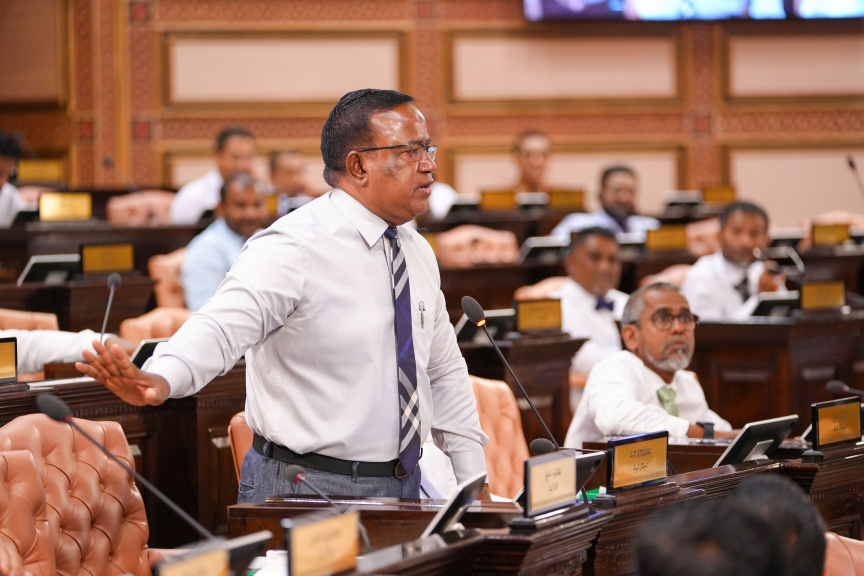
Hanimaadhoo MP Abdul Ghafoor Moosa. (Photo/People's Majlis)
Abdul Ghafoor Moosa (Gapo), a top parliamentarian from the main opposition Maldivian Democratic Party (MDP), alleges that the digital transformation bill, also known as the Maldives 2.0 bill, was submitted by the government to introduce e-voting and steal the 2028 presidential elections.
The bill, sponsored by Gadhdhoo MP Mohamed Ali, was presented at the Parliament on Monday.
During the preliminary debate, Abdul Ghafoor, the representative for Hanimaadhoo, questioned the intent behind the legislation.
“The bill is designed to pave the path to introduce e-voting. The bill was submitted to create another new office, hire employees to it, and rig the elections,” he said.
Abdul Ghafoor alleged that President Dr. Mohamed Muizzu’s administration hasn’t introduced a single bill that benefits the people.
He said that instead of establishing basic services such as sanitation, the administration is focused on rigging the upcoming elections.
Abdul Ghafoor said that while laws are introduced and revised in other countries out of noble intentions, it is done in the Maldives so it can be manipulated and taken unfair advantage of.
He said that the people have not benefited from any bill or decision from the incumbent administration.
“The electricity bill has risen drastically. The water bill is higher. Food prices have risen drastically. And the USD rate is rising to [MVR 21],” he said.
Abdul Ghafoor said that the administration had no chance of winning re-election in a fair vote.
According to the government, the digital transformation bill is designed to create a digital governance system through which the state can provide digital services in a safe, secure and sustainable manner. It is also designed to legitimize Maldives Digital Service, a new institution that will be in charge of implementing the government’s ‘Maldives 2.0’ digital transformation roadmap.
National Center for Information Technology (NCIT) was abolished and replaced with the Maldives Digital Service under a presidential directive back in January.
The bill proposes the establishment of a seven-member Digital Governance Advisory Committee within 45 days of enactment to advise the Maldives Digital Service, composed of a digital technology commissioner, a technical official from the National Cyber Security Agency, a technical official from the Communications Authority of Maldives, three experts in the field of IT or a related field, and an IT expert from the private sector.
The bill also proposes the establishment of a seven-member Digital Transformation Council to oversee the implementation of the Maldives 2.0 roadmap, chaired by the President, and composed of relevant government ministers, the digital transformation commissioner, and other experts.