date_range
Saturday 05 Sep 2026


 LOCAL EDITION
close
 LOCAL EDITION


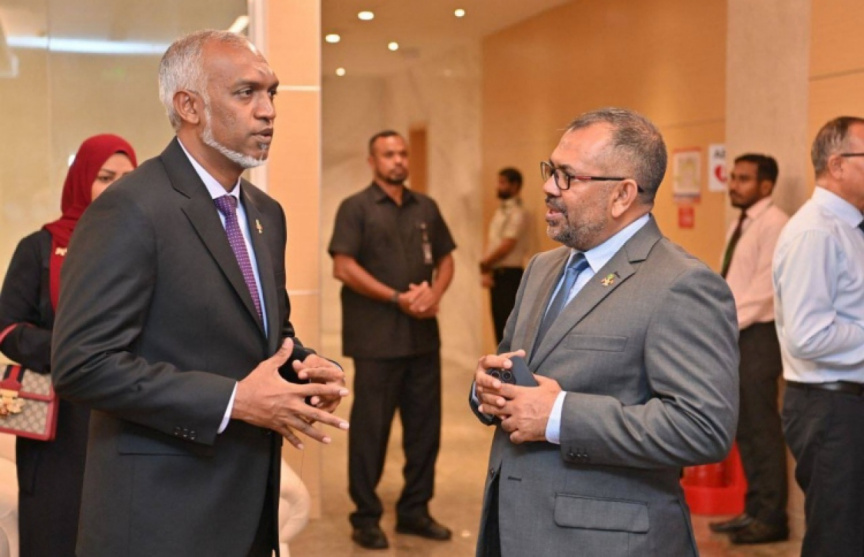
President Dr. Mohamed Muizzu (L) with the Minister of Finance Moosa Zameer. (Photo: President's Office)
After government‑owned companies were instructed to cut their staff by 33 percent on Saturday, Finance and Public Enterprises Minister Moosa Zameer said on Sunday that the total number of employees in state‑owned enterprises was estimated at 42,000.
The Finance Ministry on Saturday announced that it had asked the Privatization and Corporatization Board (PCB) to reduce employee numbers in SOEs by one‑third.
The ministry described the directive as part of efforts to reduce operating costs and strengthen cost management.
The order has been issued now amid calls for austerity measures following unrest in the Middle East since February 28. However, even as the crucial April 4 elections approached, government companies continued to announce large‑scale recruitment.
Speaking at a press conference held by the ministerial committee formed by President Dr Mohamed Muizzu to discuss measures in response to the conflict, Zameer elaborated on the instructions issued to the PCB.
— The President's Office (@presidencymv) April 19, 2026
He said government companies are constantly hiring and dismissing staff.
“But our estimate is that there will be 42,000 employed in all SOEs. The PCB, however, will maintain the data. I mean, these individual companies will maintain it. But our current estimate is 42,000,” Zameer said.
Zameer said each company had been asked to attempt a 33 percent reduction, but the actual cuts would depend on operational needs.
“To rightsize some of these companies, 33 percent may not be cut. For example, if you look at IAS, IAS is an SOE, in IAS you don’t have to reduce by that amount. If you reduce by that amount, you can’t run the company,” he said.

He said the Finance Ministry had instructed companies to dismiss employees based on their work and in line with the Employment Act. The PCB had, on Saturday, relayed the ministry’s request to the companies.
The Maldives, with a population of around 400,000, has 30,312 civil servants, bringing the total number of people employed by the state to 72,312.
Experts note that such a large share of the population working in government jobs is uncommon in developed economies. Economists say that as the state expands its payroll, a significant portion of public funds must be spent on salaries, contributing to economic strain and slowing development.
Government debt has risen sharply, and international agencies have long urged spending cuts. Although the government has pledged reforms, changes such as pension and subsidy restructuring have been delayed.
Concerns also persist over the hiring of employees in SOEs ahead of elections. MTCC alone announced 1,185 vacancies between the 1st and 28th of last month.
The government faced heavy criticism, with the opposition MDP winning most key seats in the council and women’s development committee elections. A referendum on merging the parliamentary and presidential elections also ended against the government’s position.
Following these setbacks, the President made major changes to the cabinet. Ten ministers resigned abruptly on Tuesday, and the number of ministries was reduced from 20 to 15, with new appointments made to fill the vacancies.