date_range
Tuesday 03 Nov 2026


 LOCAL EDITION
close
 LOCAL EDITION


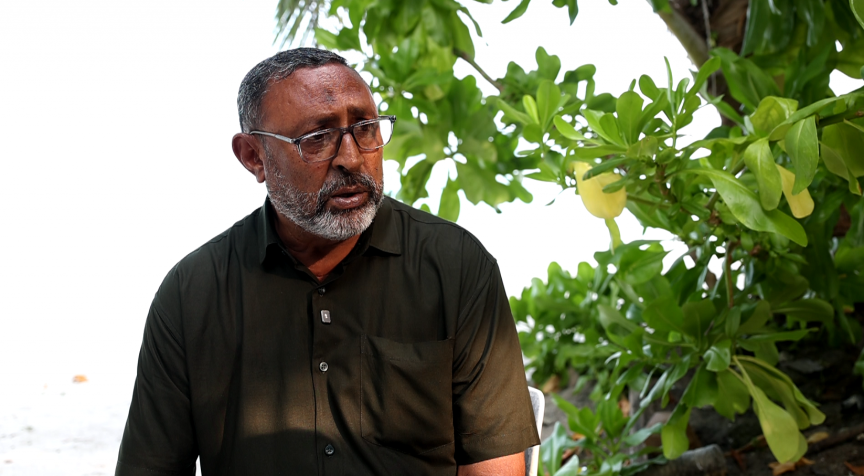
Hussain Manik. (Sun Photo)
Today marks 38 years since that terrifying incident. Although he appears composed on the outside, his facial expressions and the look in his eyes tell a different story. The anxiety and shock of those tragic moments remain visible. It is as though the terrifying and heartbreaking memories of that day continue to weigh heavily on his heart even today. These are the emotions conveyed by Hussain Manik (Ulagala Hussain Manik), who honorably retired from military service, as he recounted his painful memories of the terrorist attack on November 3, 1988.
In this interview with Sun, he recalled those terrifying experiences as though they had happened only yesterday. It seemed as if he was reliving the events all over again.

Awakened by the sound of gunfire, only assumed it was shot by mistake
Awakened by the sound of gunfire, he initially assumed that a bullet had been shot accidentally. The young Hussain, who was part of the military task force and parade unit, was preparing for a drill scheduled for November 11, 1988. The training sessions were held three times a day. It was the night of November 2. After completing his practice at 9:00 PM, he returned, had his meal, and went to bed at around 11:00 PM.
His sleeping quarters, A-Block, were situated on the side facing the Islamic Centre.
He was suddenly awakened from his peaceful and comfortable sleep by the sound of gunfire. It was 4:10 AM.
"I initially thought it was an accidental shooting, which sometimes happens during shift changes. If the established procedures are not followed properly, a firearm could go off unintentionally. That was what I assumed had happened at the time," he recalled.

However, he could not remain in his comfortable bed for long with that assumption. Gunfire was echoing throughout the surrounding area, with successive shots growing increasingly louder. The sounds of attacks on the gate of the military headquarters and the retaliatory gunfire could be heard. It was then that he realised something was seriously wrong.
Without hesitation, he jumped out of bed and hurried to get ready, putting on his task force uniform. He was alongside Ali Waheed Hussain (Thinadhoo Ali Waheed). By then, the Fajr prayer had begun. When the Imam reached the second kalimah, his voice began to tremble before falling silent. It was at that moment that Hussain truly grasped the severity of the situation.
They subsequently heard the sounds of Tamils running along the wall of the military headquarters, firing their weapons and shouting commands.
"At that moment, I told myself that we had to confront them rather than simply stand by and do nothing. With that determination, I rushed to retrieve my weapon," he said.
After quickly getting ready, the two rushed to the armory. The officer stationed there instructed everyone to load two magazines of ammunition into their weapons before leaving the armory. However, he cautioned them against wasting ammunition unnecessarily.
At the time, only one section of the armory had been opened. The section containing the largest stock of weapons and ammunition remained locked. However, Hussain was unaware of this.
Following the instructions, they had barely stepped out of the armory with their weapons when the wall at the corner of the main military headquarters was blown up. The site is near the Islamic Centre, where the Victory Monument, erected in memory of those who fell during the events of Victory Day, now stands.

There was no commanding officer nearby to issue instructions to the soldiers who had emerged from the armory. Consequently, each of them moved towards locations they considered relatively safe. Anticipating that another section of the wall might be breached, Hussain headed towards the southern wall of the military headquarters. Fearing that a group of Tamils might break through from that direction, he and several other soldiers took up positions there. Meanwhile, the sound of gunfire continued unabated.
During the aggression carried out by a group of power-hungry Maldivian traitors, the first target of the enemies who invaded Malé was Corporal Hussain Adam, who was guarding the entrance to the military headquarters and later became a martyr. Displaying extraordinary courage as he fought to repel the attack until his final moments, Hussain Adam sustained multiple gunshot wounds and embraced martyrdom. The enemies then attempted to breach the headquarters.
In addition to defending the main entrance of the military headquarters, Hussain Adam's ultimate sacrifice bought the soldiers the crucial time they needed to arm themselves and emerge from the building.
It was then that the soldiers, armed with their weapons, took up positions on top of Bandeyrige and at other strategic locations. Meanwhile, the enemies threw explosives at various sections of the military headquarters and waited for them to detonate. They could only enter the military base once they were certain that no immediate threat remained. However, while they waited, Maldivian soldiers launched attacks against the enemies and mercenaries in the area, killing several of them. According to Hussain, they were struck in the head. Among those killed by military gunfire at the time was Vasanthi, who served as one of the enemy commanders.

Hussain Manik and approximately 30 other soldiers had been stationed along the southern wall of the military headquarters for quite some time. They stood in a line, one behind the other, guarding the entire perimeter. While they were holding their positions, an elderly man who regularly brought food to the inmates arrived. Accompanied by a child, he carried black tea in one bag and dal curry with roshi in another. He distributed some of the food and refreshments among the soldiers stationed there.
As Hussain recalled, the fear and anxiety gripping him were so overwhelming that he could not swallow even a single bite of food. However, he managed to take a sip of tea. While they continued to hold their positions, the time reached 8:15 AM. Even then, the military headquarters remained under sustained attacks from all directions.
Some time later, an individual arrived searching for 10 members of the task force to report to the armory, checking various sections of the headquarters. At the time, Hussain was standing approximately four feet away from him. The other soldiers accompanying Hussain were also members of the task force. When they proceeded to the armory, they found several senior military officers there. The then-Lieutenant Moosa Ali Jaleel was also among them.
The officers instructed them to board a bus reinforced with sandbags and leave the military base. However, they had not travelled far when the vehicle came to a halt. As they stepped out to assess the situation, the enemy detonated a bomb. Several individuals were injured in the attack. Hussain subsequently returned to his previous position along the southern side of the headquarters.
While he was stationed there, an announcement was made once again calling for 10 task force personnel. He immediately hurried to the armory. Upon arrival, he found the officers waiting. They briefed the group on the developing situation and the procedures they were expected to follow after leaving the military headquarters.

Soon afterwards, the time came for them to leave the military headquarters on foot to observe the enemy's movements.
Out of the military HQ to observe enemy movements
"Major Mohamed Zahir spoke first. During his address, Major Zahir explained that the attacks were being carried out by a group of Tamils in collusion with some Maldivians, with the aim of taking away the Maldives' independence. Therefore, we had to stand firm and uphold the lessons taught by our ancestors. He said that the true value of freedom is only understood when one is forced into slavery. His briefing filled me with such determination that I began to tremble," he recalled, reflecting on the events of that day.
Major Mohamed Zahir, who was commanding the forces at the time, ordered the group to leave the military headquarters on foot. He also assigned Lieutenant Moosa Ali Jaleel to lead the group at the frontlines.
Lieutenant Jaleel then briefed them on the measures they were required to take after leaving the base. The group consisted of 11 individuals: Lieutenant Moosa Ali Jaleel, Lance Corporal Abdulla Naseem, Private Hussain Manik (Ulagala), Private Abdulla Mufeed (Lhaimagu), Lance Corporal Adam Naseer (Shady), Private Mohamed Hassan (Dhiyamigili), Private Mohamed Ibrahim (Meccano), Corporal Hussain Ali (Fukkafa Dhonthuthu), Private Ibrahim Shareef (Onuthoori), Private Mohamed Ali (Kulhudhuffushi), and Private Ali Mahir (Kudarikilu).

Of the 11 personnel, everyone except Private Ali Mahir (Kudarikilu) and Private Mohamed Ali (Kulhudhuffushi) exited through the military gate. The two men stepped out through the door and waited in the open space between the military building and the street wall. However, just as they had exited through the police office door and were preparing to proceed towards the street gate, they were ordered by Major Mohamed Zahir to retreat inside. The three personnel who were martyred during this reconnaissance patrol were Lance Corporal Adam Naseer (Shady), Private Mohamed Ibrahim (Meccano), and Private Mohamed Hassan (Dhiyamigili).
During the reconnaissance patrol, the group proceeded along the wall through the street between the Huravee Building, near the military headquarters, and the President's Office. As they headed south from the present-day President's Office lane and reached the one-way street, the enemies began firing at them. They immediately turned back along the route they had taken. As the enemies unleashed their attacks within those brief moments, the entire area became engulfed in dust.
They ran towards the rear of the Huravee Building.
"What I find astonishing is that, even though people were standing near the military gate, nobody retreated inside despite the extremely dangerous situation," he recalled emotionally, pausing in the middle of his sentence.

While he was standing in a line with two or three other soldiers, his weapon fell to the ground. From that point onwards, Hussain found himself alone. He then became increasingly concerned that soldiers inside the military headquarters might mistake him for an enemy and hit him with friendly fire. The branches of the trees had obscured his body, leaving only his legs visible, which could potentially lead the soldiers to misidentify him and open fire.
Fearing this possibility, he climbed over the wall and entered the compound of the Huravee Building. After assessing the situation from there, he decided against confronting the enemies on his own. He then removed his cap before firmly placing it back on his head.
As Hussain Manik explained, he did so to ensure that, even if he were killed, others would be able to identify him as a Maldivian soldier.
As he was leaving the Huravee Building, he noticed a group approaching from the southern side. He recognised them as Lieutenant Moosa Ali Jaleel, who had set out with him, and the surviving members of the group. As they were not looking back, Hussain began discreetly following them.

The group entered the compound of Friday Mosque, and Hussain followed them inside. Once there, they discussed returning to the military headquarters. After observing the movements of the enemies, they formed a line and prepared to move out. Lieutenant Moosa Ali Jaleel was positioned at the front, while Hussain Manik was at the rear. He believed he had been placed at the back out of concern that something unexpected might happen.
As they proceeded and reached the corner of Friday Mosque, Hussain noticed that Mufeed was missing. While searching for him, he spotted a trail of blood. It was the blood of Lance Corporal Abdulla Naseem, who had sustained a gunshot wound to the abdomen. Meanwhile, Abdulla Mufeed had experienced a sudden shock upon leaving the building, causing him to lose his composure and become unresponsive. Despite repeated attempts by his commander, Lieutenant Moosa Ali Jaleel, to communicate with him, Mufeed was unable to process what was being said. Consequently, his weapon and magazines were taken from him before he was left behind.
By then, Hussain and the others had reached a corner of the Huravee Building. At that point, Lieutenant Moosa Ali Jaleel instructed them to return to the military headquarters.
"Suddenly, Lieutenant Jaleel instructed us to enter through the police office gate. He told us to proceed straight towards the area near the Bandeyrige wall and not to stop once we reached that path."
Hussain immediately rushed forward, but he had barely taken a step through the gate when the enemies launched an attack against them. At that very moment, he felt fragments of plaster breaking off the wall and striking his body.

He quickly threw himself inside. As there was a puddle of water at the spot, he escaped without sustaining any major injuries. At the time, his head was facing the police office gate, while his feet were pointed towards the entrance. Suddenly, someone pulled him further inside the wall.
The group that had gone out managed to re-enter the military headquarters, bringing with them Private Ahmed Bushry, who had been wounded by gunfire just outside the police office gate.
This is the firsthand account of one of the brave individuals who ventured into the streets that day, risking his life in the service of the nation. It is difficult even to imagine what might have become of the country today had these individuals not demonstrated such courage and fought to defend its sovereignty.
The younger generation joining the military service today must draw lessons from these experiences and remain steadfast in defending the nation, even in the most challenging circumstances. They must be prepared to serve as the shield protecting the country's independence, whatever the cost.