date_range
Saturday 17 Oct 2026


 LOCAL EDITION
close
 LOCAL EDITION


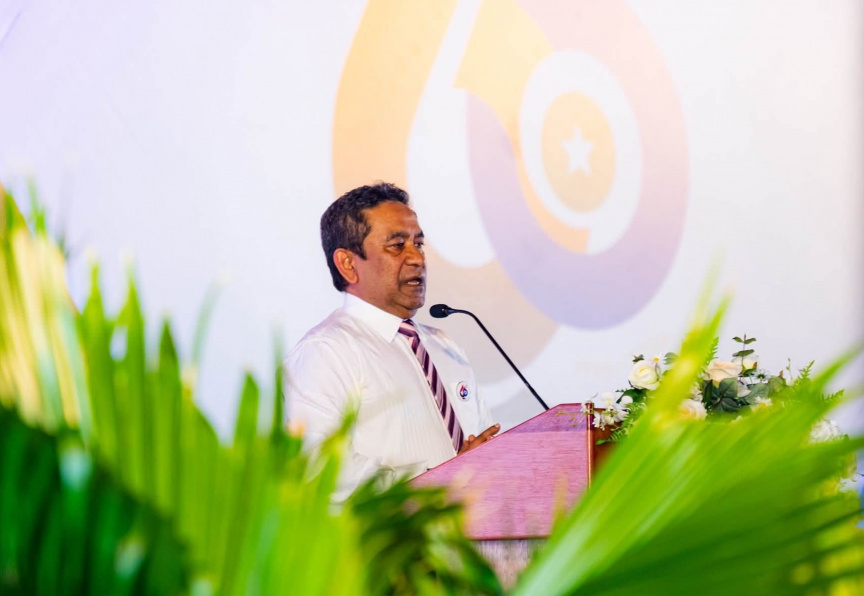
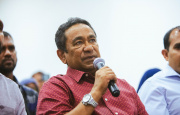
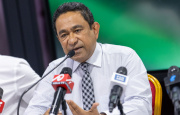
Former President Abdulla Yameen Abdul Gayoom: Yameen says drafting law after signing Rasmale’ agreement raises red flags over legality. (Photo/Thinadhoo City Council)
Former president Abdulla Yameen Abdul Gayoom, on Thursday night, citing that the government is only now drafting the relevant legislation despite having already signed the agreement for the proposed Rasmalé project, alleged that the project therefore fails to comply with the existing legal framework.
Speaking at one of the serial town hall meetings organized by the PNF, Yameen observed that neither Home Minister Ali Ihusaan nor Housing Minister Dr. Abdulla Muthalib had been able to provide the public with a justifiable explanation for the Rasmalé project.
Yameen further argued that if the government is proceeding with the Rasmalé project by circumventing established state procedures through particular interpretations of the Constitution, it is effectively undermining the authority of the Constitution itself.
He emphasized that the constitutional amendment introduced during former President Ibrahim Mohamed Solih's administration, which prohibits foreign entities from acquiring ownership of Maldivian land, remains in force.
Yameen was understood to be referring to Article 251 of the Constitution, which stipulates that no part of Maldivian territory may be ceded to a foreign party. The article also provides that any part of the Maldives may only be leased or otherwise granted to a foreign party for a maximum period of 99 years.
Yameen also drew attention to remarks made by Muthalib concerning the need to introduce specific legislation to facilitate the allocation of 500 hectares of land in Rasmalé to Eagle Hills.
"They are making the law after concluding the matter and signing the agreement; therefore, it is evident that this is not being conducted within a legal framework," he stated.
Addressing these concerns, Attorney General Ahmed Usham said at the "Ahaa" forum earlier this month that the proposed real estate legislation was not being drafted specifically for the major development planned for Rasmalé.
Usham explained that the government is seeking to establish an industry that does not currently exist in the Maldives. He said the initiative aims to develop a real estate market independent of the tourism sector, which remains the country's primary economic driver. However, he noted that the existing legal framework lacks provisions to facilitate such an industry.
He maintained that no part of the project had been undertaken in violation of Maldivian laws and regulations. Usham also stated that the agreement was signed only after the Ministry of Infrastructure, Housing and Urban Development had obtained the necessary legal advice from the Attorney General's Office.
Despite Usham's assurances, a constitutional case was filed with the Supreme Court of the Maldives seeking to invalidate the commercial agreement between the Maldivian government and UAE-based Eagle Hills for the Rasmalé project on the grounds that it violates the Constitution.
The petition argues that Article 250 of the Constitution requires the leasing or disposal of state property and assets to be carried out in accordance with the law. It further contends that, in the absence of an existing legal framework permitting state land to be allocated to a foreign entity for 99 years under such an arrangement, the agreement directly contravenes the Constitution.
The Supreme Court has since dismissed the case.
On September 21, Eagle Hills signed a commercial terms agreement or letter of intent for a mega project to develop a new integrated island destination in Rasmale’, including international hotels and resorts, premium and branded residences, a world-class marina, waterfront promenades, restaurants, shops, leisure and wellness centers.
The project is described by the Maldives government as one of the most ambitious development initiatives in the country’s history.
According to the Maldives government, preliminary economic impact estimates indicate the project could attract more than USD 30 billion in gross foreign investment over its lifetime, including about USD 18 billion in net foreign investment in the Maldives.
It is also expected to create more than 54,000 direct and indirect jobs. At full maturity, the destination is expected to attract more than one million visitors annually and generate more than USD 2 billion in annual tourism revenue.