date_range
Saturday 26 Sep 2026


 LOCAL EDITION
close
 LOCAL EDITION


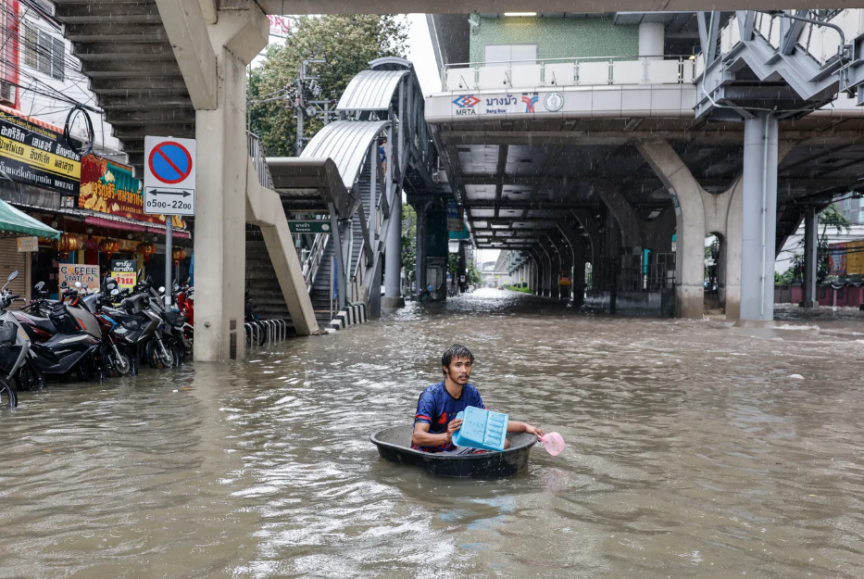
A man uses a large plastic tube to wade through floodwaters in the Bang Bua district of Bangkok on September 26, 2026. (Photo/AFP)
Bangkok authorities have declared a flood disaster across the Thai capital after almost 48 hours of heavy rain overwhelmed canals, submerged roads and flooded homes and businesses.
The Bangkok Metropolitan Administration (BMA) declared all 50 districts disaster zones on Saturday, giving local organisations special powers to respond.
The governor urged residents to stay home after almost 300 millimetres of rain fell since Thursday afternoon, while Prime Minister Anutin Charnvirakul said he was cutting short a trip to London to return.
Almost continuous rain has swollen Bangkok’s network of canals, sending murky water into surrounding homes, restaurants, shops and alleyways.
Numerous major roads were flooded on Saturday, AFP reporters saw, with residents forced to wade through knee- or sometimes thigh-deep water in several neighbourhoods.
“The water keeps coming in. It’s hard to go out now. It’s like at my waist level now,” said Somkid Pheuk-ngam, a 67-year-old vendor who lives near a canal just north of central Bangkok.
“I cannot go anywhere. I have been closing my shop for two days now,” she said.
Although her neighbourhood often floods, she said: “I think this time is worse than the 2011 flood.”
Widespread flooding across Thailand in 2011 killed more than 500 people and damaged millions of homes.
In Bangkok’s Ari neighbourhood, motorbike rider Samruay Nakkamnueng said the flooding had disrupted his journey to work.
“I woke up to go to work and the street in front of my house was flooded,” he said. “I worried if my motorbike would be able to wade through this much floodwater.”
In On Nut neighbourhood, an AFP reporter saw residents filling sandbags to protect their homes and businesses.
Authorities said they had prepared one million sandbags for distribution and opened several temporary shelters in schools.
'Every canal filled'
Bangkok Governor Chadchart Sittipunt said the east of the city had been hardest hit and warned that more rain was forecast.
“The rain keeps falling and we are doing our best. We are trying to pump the water out,” he said on social media on Saturday morning.
“The risk areas are those who live near canals. Every canal is now filled.”
Water levels later began to stabilise as the city’s pumping stations operated at full capacity, moving a combined 1,200 cubic metres of water per second, the BMA said.
“If there is no additional rainfall, the situation is expected to improve within six hours,” it said in a lunchtime update.
Chadchart urged bedridden patients who depend on life-saving medical equipment to consider temporarily moving to hospital and advised residents to move their cars to higher ground.
Bangkok’s public transport authority offered free parking at MRT park-and-ride facilities until October 2 so residents could protect their vehicles.
Once dubbed the “Venice of the East” for its canals, Bangkok is built on former marshland and sits about 1.5 metres above sea level.
Wetter than usual
Municipal workers were out on Saturday clearing rubbish to keep drains flowing.
“Our job is to make sure rubbish along the road doesn’t block the drains, so the water can drain away quickly,” said Kwan Nobnom, one of a group wearing bright orange raincoats.
“We thought this year would be dry, so we didn’t expect the flooding to be this bad.”
September marks the peak of Bangkok’s rainy season, but rainfall has been heavier than usual, according to the city’s drainage and sewage department.
The capital recorded 487 millimetres of rain between September 1 and 25, compared with an average of almost 269 millimetres for the same period between 1991 and 2020.
The Department of Disaster Prevention and Mitigation warned that low pressure would affect eastern, northeastern and central Thailand until Sunday, bringing a risk of flash floods, forest runoff, mudslides and overflowing rivers.
Scientists warn that extreme weather events will become more frequent and intense as fossil fuel emissions continue to heat the planet.
___
Source: TRT