date_range
Wednesday 23 Sep 2026


 LOCAL EDITION
close
 LOCAL EDITION


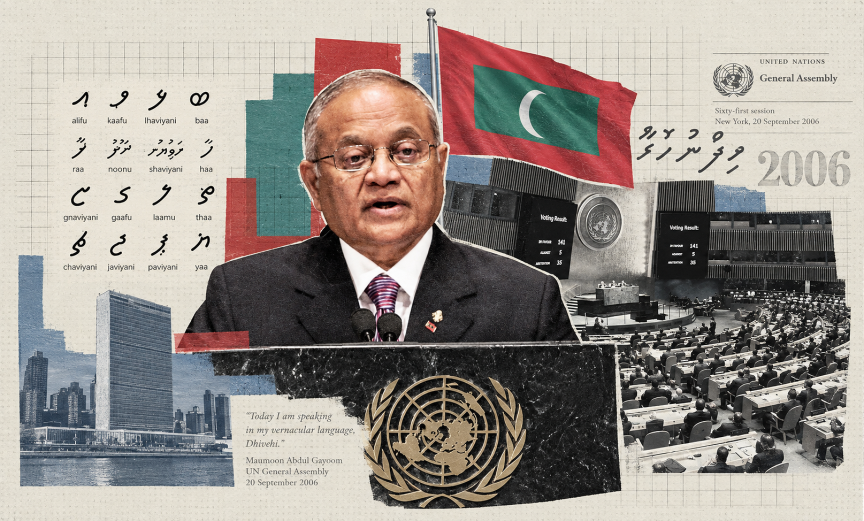
Former president Maumoon Abdul Gayyoom. (Sun Graphics/Ahmed Saail Ali)
Twenty years ago, on a morning in New York, the voice of the Maldives was heard at the United Nations General Assembly not in one of the institution's dominant languages—English, French, or Arabic—but in Dhivehi. The date was September 20, 2006. Standing before delegates from around the world at the UN General Assembly, then-President of the Maldives Maumoon Abdul Gayyoom delivered his address in the Maldivian national language.
Marking the 20th anniversary of the historic occasion, Maumoon stated in a social media post on Monday that being the first person to address the UN General Assembly in Dhivehi was a privilege. He emphasized that the decision represented more than a change in language, describing it as a demonstration that the national identity of a small state has a rightful place on the international stage.
Precisely 20 years ago today, on 21st September 2006, I had the singular privilege of being the first ever person to address UNGA in our mother tongue, Dhivehi. What an experience it was!
— Maumoon Abdul Gayoom (@maumoonagayoom) September 21, 2026
Dhivehi following Hugo Chávez’s tension-filled address
Official UN records confirm that Maumoon delivered his address in Dhivehi, with the Maldivian delegation providing an English translation. During the 61st Session of the General Assembly, Maumoon took the podium immediately after the then-President of Venezuela, Hugo Chávez who had referred to then-US President George W. Bush as "the devil” in his address. According to UN records, the tone of the Assembly changed markedly following Chávez's departure.
Maumoon opened his address by stating that the UN was at a critical juncture and emphasized the need to modernize the organization to address the challenges of the 21st century. He called for transparent and equitable reforms to strengthen the roles of the Security Council, the General Assembly, and the Economic and Social Council.
Towards the end of his address, Maumoon explained his decision to speak in Dhivehi, emphasizing that the language represents thousands of years of Maldivian history and culture. He questioned the purpose of the international community if the heritage of small and vulnerable nations could not be protected, stressing that international institutions must ensure that small states feel secure.
Human rights treaties and climate change
The address extended beyond linguistic identity and served as a comprehensive statement of Maldivian foreign policy, addressing both domestic and international challenges confronting the country in 2006. Maumoon spoke about political reforms, human rights, press freedom, and judicial reform.
Just one day before the address, on September 19, 2006, the Maldives acceded to two key UN human rights treaties: the International Covenant on Civil and Political Rights (ICCPR) and its Optional Protocol, as well as the International Covenant on Economic, Social, and Cultural Rights (ICESCR). These accessions are recorded in the UN Treaty Collection.
Maumoon also highlighted funding shortfalls affecting reconstruction efforts following the 2004 tsunami, outlining the difficulties involved in establishing housing, transportation, water, and sanitation infrastructure. He further emphasized the existential threat posed by rising sea levels to small island nations such as the Maldives and called for urgent and practical measures to address climate change.

Islam, terrorism, and peace
Another segment of the address focused on terrorism, extremism, and the growing prevalence of Islamophobia. Maumoon argued that counter-terrorism measures must not undermine the very principles they are intended to protect.
He described Islam as a foundation for peace and social harmony that promotes moderation. Rejecting attempts to associate Islam with extremism, he referenced verses from the Holy Quran to support his argument.
According to the official UN English translation, Maumoon stated: "Only love can conquer hatred. Knowledge alone can overcome prejudice. Tolerance can defeat fear.”
He also called for dialogue between different cultures and greater mutual respect.
Former Foreign Minister Ahmed Shaheed later observed that the significance of the address remains relevant today, particularly at a time when hostility and hatred around the world have intensified.
A last-minute decision and political shifts
Shaheed revealed on social media that the decision for Maumoon to deliver the address in Dhivehi was made at the last minute. Although he could not recall who initially proposed the idea, he said the decision was finalized on the afternoon of September 19, one day before the speech. The period coincided with significant developments in the Maldivian political landscape. While the Maldives acceded to international human rights treaties on September 19 and Maumoon addressed the UN on September 20, then-MDP Chairman Mohamed Nasheed was released from custody the following day, September 21, 2006. The address therefore carried not only cultural significance but also took place during a pivotal period in Maldivian political history.
At a time when international diplomacy was largely conducted in major global languages, Maumoon's decision to deliver the address in Dhivehi incorporated the language more prominently into the Maldives' diplomatic identity. Despite the country's small population and geographical size, the speech demonstrated the Maldives' distinct linguistic, historical, and cultural identity. Two decades later, many of the issues raised in the address—including the vulnerability of small states, climate change, human rights, and terrorism—remain significant on the international agenda.
With the address, the official UN records included the notation: "President Gayoom (spoke in Dhivehi; English translation provided by the delegation)," formally recording Dhivehi in the history of the United Nations.