date_range
Saturday 19 Sep 2026


 LOCAL EDITION
close
 LOCAL EDITION


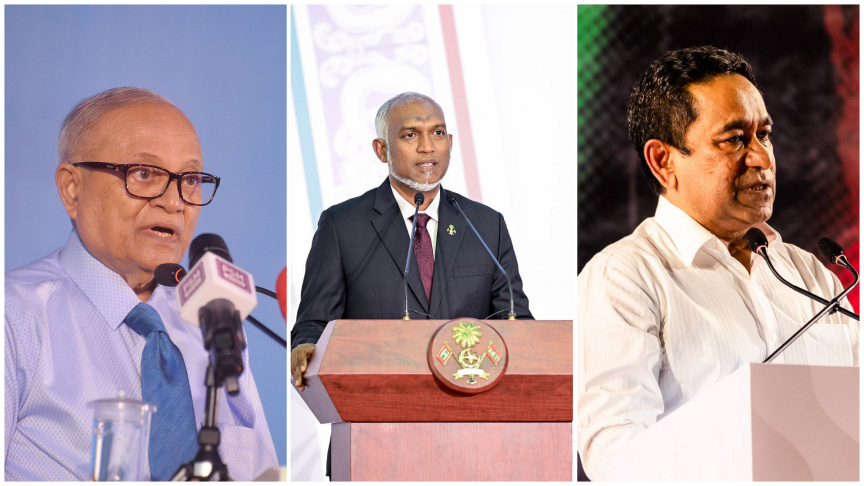
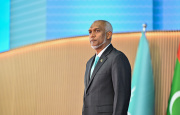
Combined photos of (from L-R) Maumoon Abdul Gayoom, Dr. Mohamed Muizzu and Abdulla Yameen Abdul Gayoom.
President Dr. Mohamed Muizzu pushed back on criticism by former President Abdulla Yameen Abdul Gayoom regarding the state of the Maldivian judiciary on Friday, highlighting on the “difficult” conditions under which his brother, former President Maumoon Abdul Gayoom and other opposition leaders were jailed during his administration.
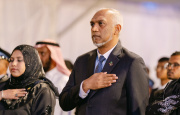
Addressing the closing of the ruling People’s National Congress (PNC), during which he was presented with the party’s ticket for his 2028 re-election campaign, President Muizzu said that the Maldivian judiciary faced dark days in the past, “with judges kidnapped and judges arrested by removing the tin roof of the Supreme Court.”
His remarks refer to a period of political turmoil during Yameen’s administration when opposition leaders, including Maumoon, were jailed. The Supreme Court issued a court order on February 1, 2018, ordering their release. The order prompted Yameen to declare a state of emergency and arrest two Supreme Court judges – Ali Hameed and Abdulla Saeed. The “tin roof” remark refers to their contentious arrest. The judges were later investigated for bribery, and were jailed for refusing to surrender their phones to investigators.
President Muizzu, who was serving in Yameen’s administration as housing minister at the time, said he visited the Dhoonidhoo Custodial Jail to check up on them at the request of several cabinet members.

“It was a very difficult experience for me… They were kept in solitary cells, or in very difficult conditions… I experienced this first hand. This was the extent to which the judiciary was free,” he said.
President Muizzu said that the judiciary must be completely free in order to practice good governance. He provided assurance the judiciary has not faced any government interference since he assumed office in 2023.
“On November 17, 2023, in my inaugural speech, I declared that the judiciary was free from that moment on, that it was now free. Take a look at from that moment on until today, whether the judiciary is free or not. The government does not exert influence to any extent. To any extent!” he said.
President Muizzu said his administration had also resolved budgetary constraints to facilitate the work of the judiciary, and had expedited the stalled project to build a superior court complex.

He said that he was working on establishing justice in the Maldives without any discrimination.
“I will establish justice in this country in the full sense of the word. This means that criminals will be punished. It doesn’t matter who the person is, who their parents are or which party they are from” he said.
President Muizzu had contested the 2023 presidential elections after a criminal conviction that was later overturned disqualified Yameen from entering the race himself. Though he initially asked the then-opposition PPM-PNC (Progressive Party of Maldives-People’s National Congress) coalition to boycott the election, he later endorsed President Muizzu, who won the vote taken by the coalition’s joint senate to produce a backup candidate.
Yameen was transferred home on October 1, 2023 – a day after President Muizzu won the presidential election.

But less than a week after President Muizzu took office in November, Yameen left the ruling PPM-PNC and initiated efforts to form a new party, the People’s National Front (PNF).
He later grew increasingly vocal in his criticism of President Muizzu’s administration, and has repeatedly alleged that President Muizzu and other members of the PPM-PNC leadership had never wanted him freed. President Muizzu, meanwhile, maintained that Yameen’s freedom was a matter for the courts, and that he would not influence it in any manner.