date_range
Wednesday 16 Sep 2026


 LOCAL EDITION
close
 LOCAL EDITION


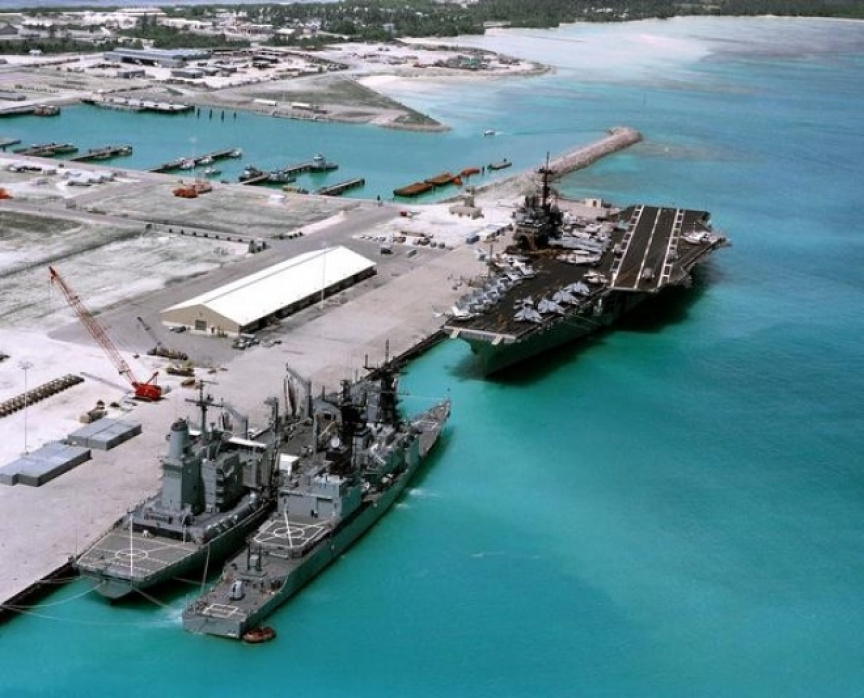
Chagos, which is a part of British Indian Ocean Territory.
The following is an op-ed by Brigadier General (Retired) Ahmed Nilam.
____
For decades, the global discourse surrounding decolonization has operated within a complex framework of international law, diplomatic negotiation, and strategic security management. Major powers have frequently balanced historical administrative legacies with evolving global norms on territorial integrity. Central to this era was the practice of utilizing regional administrative structures and bilateral arrangements to navigate post-colonial transitions. However, as international jurisprudence evolves, long-standing strategic arrangements in the Indian Ocean are undergoing structural reassessment, forcing a re-examination of how historical colonial frameworks align with contemporary international law.
The roots of current territorial discussions trace back to foundational administrative decisions from the colonial era. Under the 1814 Treaty of Paris, Great Britain acquired Mauritius and its associated territories—a governance model that frequently relied on broad administrative categorizations rather than detailed itemization of individual island groups, such as the Chagos Archipelago. Historical partnerships also shaped this period. Under the 1887 Protectorate Agreement and through both World Wars, the Maldives maintained a close cooperative relationship with the British Crown, leasing facilities such as Addu Atoll (Gan) for naval support. However, when administrative arrangements shifted in 1965 to separate the Chagos Archipelago for the establishment of the British Indian Ocean Territory (BIOT) and a joint defense facility, the process involved complex geopolitical negotiations that impacted local populations, including the displacement of Chagossian residents prior to Mauritian independence in 1968. These historical actions have since become central to modern legal and human rights debates.

The long-term viability of mid-20th-century administrative arrangements has been heavily tested by the evolution of international law, particularly concerning UN frameworks and maritime governance. Landmark instruments such as UN General Assembly Resolution 1514 (XV) established that any disruption of the national unity and territorial integrity of a country is incompatible with the Charter of the United Nations. Subsequent advisory opinions from bodies such as the International Court of Justice (ICJ) and UN General Assembly resolutions explicitly analyzed the 1965 detachment of the archipelago through the lens of international decolonization standards. Furthermore, under the United Nations Convention on the Law of the Sea (UNCLOS), coastal and archipelagic states exercise sovereign rights over adjacent maritime zones, exclusive economic zones (EEZs), and continental shelves. Jurisprudence from international tribunals has highlighted how colonial-era separations intersect with modern maritime boundaries, reinforcing the legal agency of newly independent regional states.
Beyond legal doctrine, the management of strategic outposts faces a shifting operational environment. For decades, remote island installations were viewed through the lens of geographical isolation, offering a natural buffer against conventional regional conflicts. However, modern advancements in long-range precision guidance systems and extended-range capabilities have prompted defense analysts to re-examine traditional security assumptions. Contemporary defense strategies increasingly emphasize comprehensive, multi-layered security measures rather than relying solely on geographic distance. Furthermore, the transition toward negotiated sovereignty frameworks—such as the 2025 UK-Mauritius agreement providing a long-term lease arrangement to secure military outposts—illustrates how major powers adapt to international legal pressures while attempting to preserve essential strategic stability.
As traditional administrative footprints evolve, regional actors continue to navigate their own strategic and diplomatic priorities. Administrations across the wider South Asian rim frequently engage in broader discussions regarding maritime boundaries, regional heritage, and sovereign rights within vital global trade corridors. The intersection of shifting superpower footprints and regional aspirations highlights the importance of cooperative security frameworks. Ensuring stability across maritime arteries connecting East Africa to South Asia and Southeast Asia requires transparent multilateral engagement to prevent competitive friction and safeguard vital economic growth corridors.
Ultimately, the evolving status of the Chagos Archipelago and the broader Indian Ocean underscores the complex legacy of historical administrative decisions. Territorial arrangements established under different geopolitical contexts face inevitable reassessment as international norms, UN legal standards, and security environments change. As global powers and regional states navigate these transitions, the situation highlights the enduring need for transparent, cooperative frameworks that balance strategic stability with respect for international law and regional development.