date_range
Tuesday 25 Aug 2026


 LOCAL EDITION
close
 LOCAL EDITION


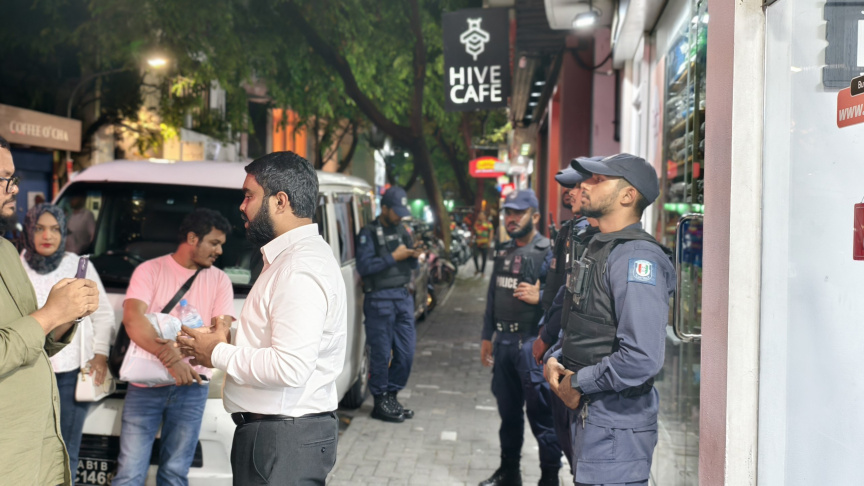
Adhadhu reporters livestream as police stand guard outside the vacated office during a court‑ordered search, April 27, 2026. (Sun Photo)
The Criminal Court has ruled that items seized by police from the office of Adhadhu News cannot be returned at this stage, stating that there is no legal basis to release the equipment while the investigation remains ongoing.
Police seized Adhadhu’s digital equipment on the night of April 27 as part of the investigation linked to the outlet’s documentary on the case of Aisha. The court had previously granted police access to information stored on the seized digital devices.
In its latest ruling, issued by Judge Ibrahim Zihuny, the Criminal Court said some of the equipment taken from Adhadhu’s office cannot be handed back because the police investigation has not yet concluded.
Last March, Adhadhu CEO Hussain Fiyaz Moosa and Managing Editor Hassan Mohamed were summoned for questioning in connection with the case, and their passports were seized for three months.
The court has also issued a gag order preventing Adhadhu from publishing content related to the case. Fiyaz has filed a petition in the High Court seeking to overturn the gag order. The hearing was scheduled to begin at 9:15 am on June 29, but was cancelled shortly after 9:00 am. Prosecutor General’s Office lawyers, Fiyaz, and Fiyaz’s legal team were present in court. The High Court did not provide a reason for the cancellation.

Two Adhadhu journalists, Leevan Ali Naseer and Mohamed Shahzan, were also jailed in connection with the case. Transparency Maldives condemned the arrests and the broader actions against Adhadhu as an attack on the foundations of democratic governance.
The case has drawn significant international attention, with major foreign media outlets and press-freedom organisations expressing concern over the raid, gag order, and treatment of journalists.
For context, the actions taken against Adhadhu stem from the outlet’s documentary Aisha, which examined allegations made by a former presidential aide regarding misconduct and abuse of power at the highest levels of government. The documentary triggered a police raid on Adhadhu’s office, the seizure of newsroom equipment, the arrest of two journalists, and a gag order restricting coverage. Media groups and rights organisations have described the response as disproportionate and politically motivated, warning that the measures appear aimed at suppressing reporting on allegations that implicate senior officials.