date_range
Tuesday 25 Aug 2026


 LOCAL EDITION
close
 LOCAL EDITION


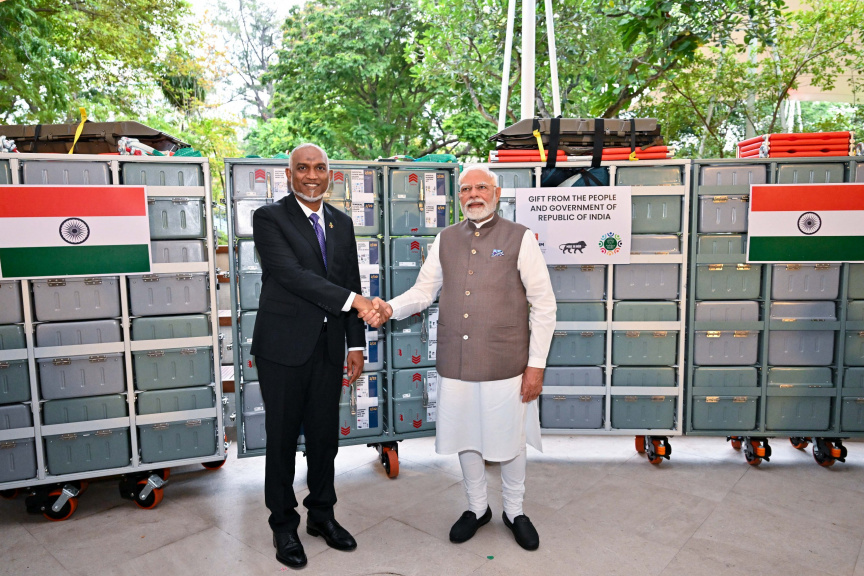
President Dr Mohamed Muizzu (L) with Narendra Modi, Prime Minister of India during his state visit on July 25, 2025. (Photo/President's Office)
The following is an op-ed by Rishi Suri.
For decades, discussions about India–Maldives relations have tended to revolve around Malé. Diplomacy happens in the capital, governments negotiate there, and political debates emerging from Malé inevitably dominate headlines. But the future of the India–Maldives partnership may increasingly be shaped elsewhere: in Addu, Hithadhoo, Hanimaadhoo and dozens of island communities where development cooperation is becoming visible in everyday life.
This represents an important evolution in the relationship. The strongest partnerships are not measured only by agreements signed between governments. They are measured by whether people can see improvements in their roads, homes, airports, water systems, healthcare facilities and economic opportunities.
India’s development partnership with the Maldives is increasingly moving in precisely this direction.
One of the clearest examples is Addu City. In July 2025, President Mohamed Muizzu and Prime Minister Narendra Modi jointly inaugurated the India-funded Addu Roads and Drainage Project. The project includes roads, street lighting, storm-water drainage and other infrastructure intended to strengthen Addu’s emergence as the Maldives’ southern regional hub.
This matters because geography has always presented the Maldives with a distinctive development challenge. An archipelago spread across a vast expanse of the Indian Ocean cannot build an inclusive economy if opportunities remain excessively concentrated around Greater Malé.

Addu therefore represents more than another infrastructure project. Better roads and drainage improve daily life, but they can also support tourism, businesses and investment. Combined with the redevelopment of Gan International Airport, which India is supporting through a Line of Credit of about $29 million, the objective is effectively to strengthen Addu as a tourism gateway and economic hub for the southern Maldives.
The same philosophy can be seen in housing.
During Prime Minister Modi’s July 2025 visit, the two leaders marked the ceremonial handover of 4,000 social housing units financed through India’s Buyer’s Credit facility. Seven hundred had already been handed over during President Muizzu’s October 2024 visit to India, with the remaining 3,300 forming part of the 2025 handover.
Housing is one of the Maldives’ most pressing domestic challenges. President Muizzu has repeatedly placed it at the centre of his government’s agenda. Indian financing therefore intersects with a priority that is fundamentally Maldivian rather than externally imposed.
Perhaps even more significant, however, are the smaller projects.
Alongside the major infrastructure initiatives, India and the Maldives have developed a network of High Impact Community Development Projects. Six such projects were inaugurated during Modi’s 2025 visit: outdoor gyms in Hithadhoo and GDh Vaadhoo, a youth centre in GA Gemanafushi, a volleyball court in Sh Kanditheemu and a small-scale fish-processing plant in Hithadhoo.
Individually, these projects do not attract the attention generated by a major bridge or airport. Collectively, however, they may have an equally important political and social effect.
A youth centre creates a space for young Maldivians. A fish-processing facility can support livelihoods. An outdoor gym improves community amenities. Water and sanitation infrastructure transforms basic living conditions. These are projects whose value can be understood without reference to geopolitics.
That is particularly important for India and the Maldives.
The relationship has experienced periods of political turbulence, demonstrating how quickly bilateral ties can become entangled in domestic political narratives. Development cooperation offers a different foundation because its results are measurable. A completed road cannot easily be reduced to a diplomatic slogan. Neither can a family receiving a home nor an island gaining reliable water infrastructure.

The geographical spread is therefore as important as the scale of assistance.
India-backed water and sanitation projects, for example, have covered dozens of islands, with projects on 28 islands already handed over to the Maldivian government. Hanimaadhoo International Airport in the north has also been redeveloped with Indian financing, creating another potential regional gateway beyond Malé.
The opportunity now is to connect these individual projects into a broader vision of decentralised Maldivian development.
Addu can develop further as a southern tourism and commercial hub. Hanimaadhoo can strengthen northern connectivity. Fisheries infrastructure can generate more economic activity closer to island communities. Community projects can focus on youth, sport, healthcare and local enterprise. Housing and essential services can help reduce some of the pressures created by excessive concentration around the capital.
This approach would also make the India–Maldives partnership more resilient.
Governments change. Political rhetoric changes. Strategic circumstances change. But partnerships embedded in communities develop constituencies of their own. When cooperation delivers something useful to ordinary citizens, bilateral relations cease to belong exclusively to diplomats and political leaders.

There is also an important principle involved. India does not need to determine what development should look like for the Maldives. Maldivians themselves must set those priorities. The most sustainable model is therefore one in which Maldivian governments and communities identify their requirements while Indian financing, expertise and capacity help turn selected priorities into reality.
The next chapter of India–Maldives relations should consequently be judged not simply by how many agreements are signed in Malé, but by how widely their benefits are distributed across the archipelago.
The journey from Malé to Addu is ultimately about more than geography. It represents a transition from a relationship dominated by capitals and strategic debates towards one increasingly grounded in communities, connectivity and everyday development.
And that may prove to be the strongest foundation on which India and the Maldives can build their future together.
---
Rishi Suri is editor and director of The Daily Milap, India’s oldest and largest Urdu newspaper. He writes on geopolitics, strategic affairs, and regional diplomacy, with articles published in leading international publications.