date_range
Sunday 20 Sep 2026


 LOCAL EDITION
close
 LOCAL EDITION


Then-president Ibrahim Mohamed Solih meets then-president elect Dr. Mohamed Muizzu following the latter's election win. (Photo/The President's Office)
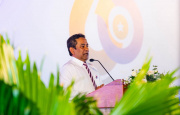
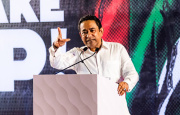
Former President Abdulla Yameen Abdul Gayoom alleged on Saturday night that the Maldivian economy went downhill after President Dr. Mohamed Muizzu continued what he described as the "irresponsible legacy" of former President Ibrahim Mohamed Solih.
Speaking at a town hall meeting organized by his party, the People's National Front (PNF), Yameen outlined his assessment of the country's current economic situation.
Yameen said money "cannot be printed" indefinitely and argued that the Maldives Monetary Authority (MMA) cannot continue injecting funds into the economy without consequences. He claimed that additional liquidity released into the market could drive the exchange rate of the US dollar to as high as MVR 25, describing the current situation as a result of such monetary policies.
"Despite claims of not printing new notes, this situation arises when money that was not in circulation is released through the MMA. The issue isn't a lack of dollars entering the country; it's that there is an excess of Maldivian Rufiyaa chasing those dollars," Yameen said.

He also expressed the view that the challenges President Muizzu had been unable to address over the past three years were unlikely to be resolved within the remaining two years of the current presidential term.
Yameen further accused President Muizzu of continuing what he described as President Solih's "irresponsible legacy," arguing that the country's economic decline began as a result.
The Maldivian economy is currently facing significant challenges, with the black market exchange rate of the US dollar remaining on an upward trend. The dollar has traded above MVR 20 for an extended period, and despite the government's repeated assurances and deadlines to reduce the exchange rate, those efforts have yet to produce the intended results.
President Muizzu was elected with the backing of Yameen after the former president was barred from contesting the presidential election following his corruption conviction. However, the relationship between the two deteriorated within days of the new administration taking office. Yameen later left the ruling coalition to establish the People's National Front and has since emerged as one of the government's most outspoken critics, repeatedly making allegations against President Muizzu and his administration.