date_range
Friday 23 Oct 2026


 LOCAL EDITION
close
 LOCAL EDITION


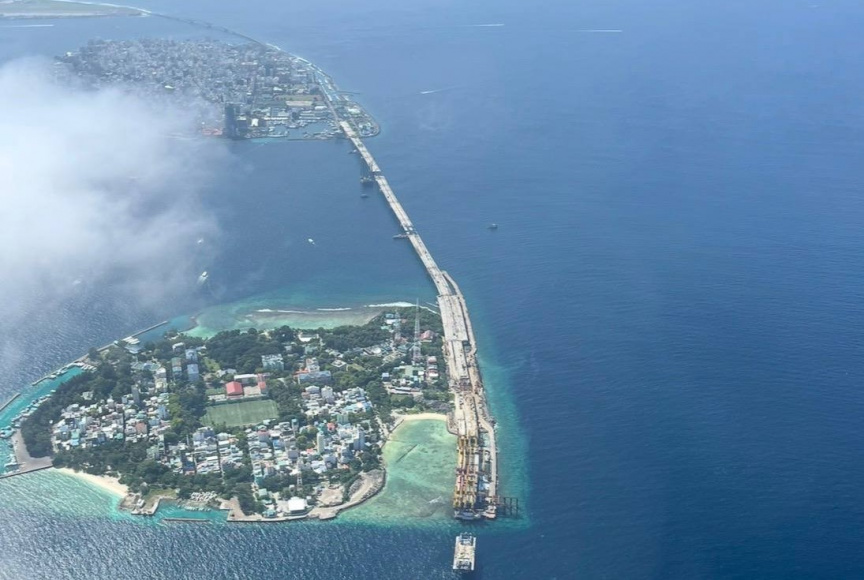
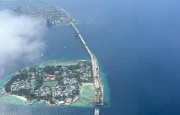
An aerial shot of the Thilamale' Bridge under development between Male' and Vilimale'. (Sun Photo)
If you have taken the ferry between Malé and Vilimale or waited some time near Dharumavantha Hospital recently, you may have noticed something that is hard to look away from.
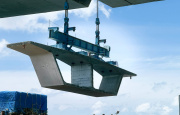
The structure of the bridge connecting the two islands now stands largely complete against the horizon — steel and concrete arching across open water, drawing the outline of something that, not long ago, existed only in blueprints and promises.
The Greater Malé Connectivity Project — the GMCP — is the largest infrastructure project in Maldivian history. Funded through a US$500 million package from India, comprising a grant and a line of credit, it will eventually create a 6.74 kilometre network of bridges and causeways connecting Malé to Vilimale, Gulhifalhu and Thilafushi.
But right now, it is the Malé-Vilimale section that is catching eyes. And it should. Because what is emerging out of the water is not just a bridge. It is a statement that something is genuinely moving forward.
For the people of Vilimale, this bridge is personal.

For years, residents have organised their entire lives around ferry schedules. Early morning medical appointments in Malé. Late evening returns home after work. Children crossing open water every school day. The ferry is affordable and familiar, but it is also a constraint — a small but constant reminder that home and opportunity are on two different sides of the water.
When that bridge opens, that constraint disappears. For the first time, Vilimale will feel like a neighbourhood rather than a separate island.
But the significance of the GMCP goes much further than commuter convenience. Gulhifalhu is set to become a major residential and port development zone — a place where thousands of Maldivians could one day build homes, raise families and access jobs without having to fight for space inside an already crowded Malé.
Thilafushi, long known more for industrial activity than possibility, is being developed as the country’s primary logistics and industrial hub. Proper connectivity to these islands opens up economic space that Malé simply cannot provide on its own.
This matters enormously for a country like ours.
Malé is one of the most densely populated places on earth. Housing is expensive. Roads are congested. Land is scarce. For decades, those pressures have squeezed the economic potential of the capital region without any real release valve. The GMCP is that release valve — a way to spread people, business and opportunity across a wider area while keeping everything connected.
There is also a broader lesson here. Our economy leans heavily on tourism. It has been that way for a long time, and tourism remains vital — more than 1.5 million visitors come to the Maldives each year, contributing around one-fifth of our GDP.
But the pandemic showed us, painfully, what happens when that single pillar shakes. Arrivals collapsed. Revenue dried up. The vulnerability of overdependence became impossible to ignore.
Infrastructure like the GMCP is part of the answer to that vulnerability. Stronger logistics. New industrial zones. Expanded housing. Better connections between workers and workplaces. These are the foundations on which a more diversified economy can eventually be built. They do not make headlines the way political stories do, but they shape the daily reality of ordinary people for decades.
Projects like this are also where the real measure of international partnerships is found. Not in speeches or communiqués, but in concrete and steel that actually goes up. India’s investment in the GMCP — the largest development project it has undertaken in the Maldives — is meaningful precisely because it is visible, physical and permanent.
Whatever the political weather between our two countries on any given day, this bridge will still be standing.