date_range
Sunday 25 Oct 2026


 LOCAL EDITION
close
 LOCAL EDITION


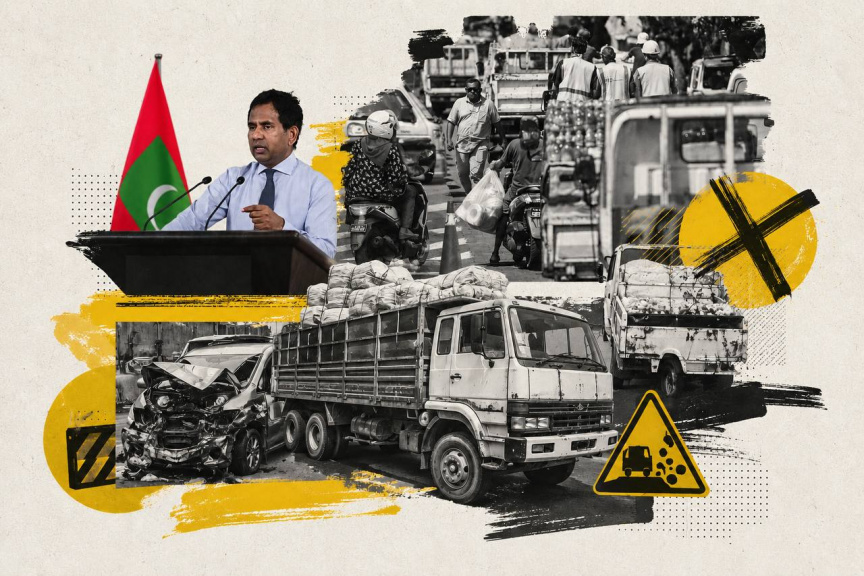
I left the office and headed towards the bridge, expecting nothing more than a pleasant end to the day. As I drove along Boduthakurufaanu Magu, the clear skies and sweeping view of the sea offered a sense of calm. Never, even in my darkest imagination, did I expect that I would encounter a heavy vehicle running over a human.
Yet, that is exactly what happened. Witnessing someone lose their life with such severe injuries on a street in Malé deeply affected me. I never want to see such a scene repeated. However, that will only be possible if meaningful changes are brought to the way Malé is managed.
A Congested City Filled with Peril
Malé City, the capital of the Maldives, is one of the most densely populated places in the world. This small area is so densely packed with buildings and vehicles that it often feels suffocating. The moment you step onto a road, danger approaches from all four directions.
Among the greatest hazards is the daily commute, during which the public must share the roads with massive vehicles carrying tons of cargo. Seeing lorries transporting huge containers and dump trucks loaded with stones and sand weaving through motorcycles and cars instills fear in the hearts of ordinary citizens. The high volume of these vehicles on the roads during school hours—when parents are commuting with young children—and during busy office rush hours is one of the leading causes of accidents.
"When I take my child to school, there is usually a one-ton pickup overloaded with water tanks in front of us. Behind us, there are two or three other pickups packed with goods. Just think about it—if you even brush against the side of one of those vehicles, you're done for," a friend shared during a catch-up over coffee last night, recounting his anxieties after I described yesterday's horrific accident.
Regulations Exist Only on Paper
This is a genuinely alarming concern. At present, no special regulations are being enforced for cargo and heavy vehicles in the Greater Malé area. It is not that these rules do not exist on paper; rather, a simple five-minute walk on the streets confirms that they are not being enforced at all. Vehicles carrying tons of cargo are driven recklessly even during peak hours. Container trucks operate whenever they please. This is the reality in both Malé and Hulhumalé.
"It’s not just about a vehicle overturning or causing property damage. Some of these heavy vehicles are driven as if they are racing. They drive very fast in this cramped Malé and Hulhumalé. Imagine the catastrophic damage if one of these vehicles loses control," said Ahmed Ali, 56, who spends most of his time on the road working as a taxi driver.
The Politics of Enforcement
During former president Abdulla Yameen Abdul Gayyoom's administration, a robust policy was introduced and enforced to address this issue. Under that policy, heavy cargo vehicles were permitted on Malé's streets only during low-traffic hours, specifically avoiding school commute times and office rush hours. When the policy was enforced, the results were highly positive; road congestion eased, and dangerous accidents declined.

However, in the Maldives, it is rare for one government to continue the initiatives of its predecessor. Consequently, from the administration of former President Ibrahim Mohamed Solih to the current government of President Dr. Mohamed Muizzu, this robust policy has remained unenforced. Today, heavy cargo vehicles operate without effective regulation or restraint. Although the Ministry of Transport sets specific operating hours during certain periods, such as Ramadan, no effective measures are maintained throughout the rest of the year.
Speaking on the condition of anonymity, a senior official from a traffic management enforcement agency stated that establishing and enforcing designated operating hours for heavy vehicles is a critical necessity that has long been left unfulfilled. He noted that this failure stems from the Ministry of Transport hesitating or neglecting to draft the required regulations and implement the necessary enforcement measures.
The official emphasized that while cargo transportation is essential, it can be managed efficiently by designating specific operating hours.
"For example, outside of school hours: 09:00 to 12:00 in the morning, 14:00 to 16:00 in the afternoon, and after 22:00 at night. These should be the hours for cargo transport. That way, goods can be moved without disrupting businesses," the official said.
"This policy is incredibly important. But it has simply been neglected."
Global Standards vs. Local Inaction
Other countries implement strict regulations to reduce the dangers associated with heavy vehicles operating alongside public traffic.
• Singapore: Authorities heavily prosecute drivers for accidents caused by negligence involving heavy vehicles. The country's police recently charged five drivers following separate incidents in which heavy vehicles lost control.
• Australia: In states such as New South Wales, installing specialized speed limiters is mandatory to control the speed of heavy vehicles. In addition, dedicated camera systems are installed across roads specifically to monitor heavy vehicles.

• Canada: In Quebec, heavy vehicle drivers are legally required to complete specialized training, and safety protocols governing the operation of these vehicles have been significantly strengthened. These measures were introduced following tragic fatal accidents involving heavy vehicles.
If similar robust measures are not introduced in Malé, the dangers on our roads will continue to escalate. At present, a new bill has been submitted to the People's Majlis to amend the Land Transport Act. Taking urgent action to regulate heavy vehicles—either through this bill or by introducing direct Ministry of Transport regulations—is vital to protecting public safety.
At present, the relevant authorities have not made a definitive decision to resolve this issue, leaving the public anxiously awaiting a swift solution. No one ever wants to witness a tragedy like the one seen yesterday. Preventing such incidents, however, requires the introduction—and strict enforcement—of robust regulations.