date_range
Sunday 20 Sep 2026


 LOCAL EDITION
close
 LOCAL EDITION


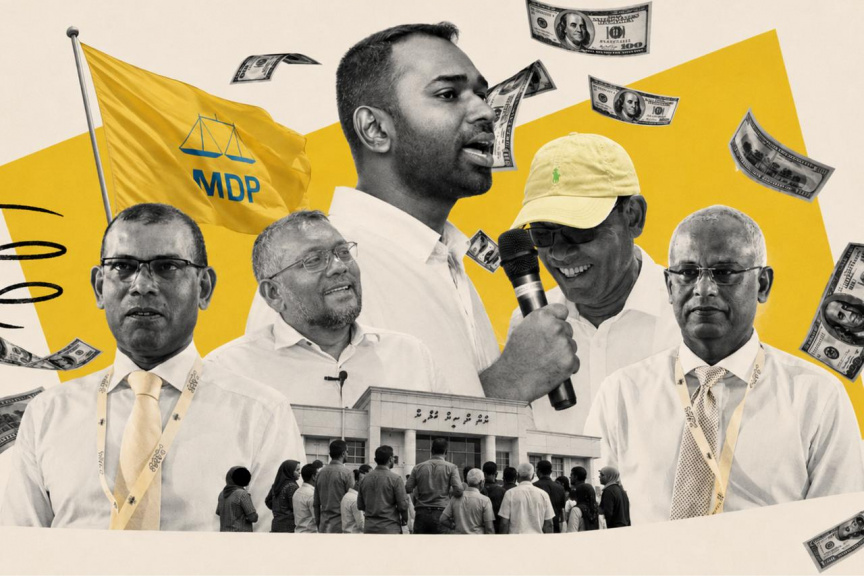
Intense rilvalry for MDP's chairperson ship as two factions battle it out. However, a concerning scene on display from both sides. (Sun Graphics)
"A monkey can't sell bananas." This is a powerful warning about trust, integrity, and ethics. A monkey is naturally drawn to bananas and is unlikely to sell one when given the opportunity; instead, it will consume it itself. In the same way, it is impossible to place a country on the right path, pursue development, and implement meaningful reforms while surrounding oneself with "thieves." As long as such individuals remain close to positions of influence, reform cannot be achieved. Only a mess can be created.
This analogy reflects the delicate and fragile situation within the Maldivian Democratic Party (MDP), currently the Maldives’ largest opposition political party. As party members prepare to elect a new Chairperson, it has become one of the most widely discussed political topics in the country. Who will emerge victorious in this latest chapter of the political rivalry between former presidents Mohamed Nasheed and Ibrahim Mohamed Solih? Although the election is formally between Nasheed and South Galolhu MP Meekail Ahmed Naseem, it is widely viewed as another extension of heated rivalry between Nasheed and Solih.

However, a far more important question remains. Has the MDP undergone genuine change as it regains public confidence and ergo, is achieving electoral success? The answer to this question should not concern only party members. It is a matter of interest to every citizen who believes the Maldives deserves a better political environment. Amid the party’s internal divisions and power struggles, the central issue—integrity—has been pushed aside.
From a democratic standpoint, a highly competitive and energetic internal party election is a positive development. Such contests are a normal and healthy feature of democratic politics. Nevertheless, the intense Chairperson election campaign has once again exposed a troubling reality. Prominent figures on both sides of the contest include individuals who have faced allegations of corruption, abuse of power, questionable political dealings, illicit enrichment, and contributing to weaknesses in governance. Despite these allegations, they continue to wield influence at the highest levels of the party. As the election approached, individuals facing similar accusations aligned themselves with different factions, seemingly in search of political protection.
The issue is not that some support Nasheed while others support Solih. Political competition is both healthy and necessary in a democracy. The real concern is that neither side appears willing to draw the line between the mistakes of the past and the aspirations of the future. The continued presence, within the party’s decision-making circles, of individuals linked to allegations surrounding the MMPRC corruption scandal, misconduct within state-owned enterprises, the ventilator scandal, corruption at Fenaka, and the politically influenced allocation of flats and land plots undermines public confidence.
"How can reform be achieved by surrounding themselves with people who ran projects while taking cuts? They are still lingering right behind the party leaders. Tomorrow, when power is gained, they will clear out another company to buy another plot of land. This is not the reform we want," said a young MDP member who was disgruntled by the presence of corruption-accused individuals in the internal election campaign.
Around the world, voters are increasingly unwilling to support political parties that fail to address corruption within their own ranks. Research conducted by organizations such as the International Foundation for Electoral Systems (IFES) consistently demonstrates that corruption erodes public trust, weakens democratic institutions, and discourages civic participation. Anti-corruption efforts are most credible when political parties apply the same standards internally that they demand from others.
This principle is especially important for an opposition party. One of the opposition’s primary responsibilities is to hold those in power accountable. It must scrutinize government expenditure, expose wrongdoing, and advocate for transparency. However, when opposition leaders are surrounded by individuals whose own records raise serious concerns, the credibility of those efforts is weakened. An opposition party gains the moral authority to criticize government misconduct only when it demonstrates integrity itself.
For this reason, the challenge confronting the MDP today extends far beyond the election of a Chairperson. It is fundamentally a question of trust. Many supporters argue that the party’s foremost priority should be defeating the government at the next election. Yet electoral success and political reform are not mutually exclusive goals. On the contrary, successful democratic parties strengthen their position by demonstrating that accountability applies to everyone.

A notable example can be found in Japan, where the ruling Liberal Democratic Party (LDP) faced significant public backlash following major political funding scandals involving unreported funds and senior politicians. The controversy ultimately led to the resignation of several high-ranking party figures. The episode illustrates how quickly public trust can be lost when political parties fail to uphold ethical standards. The belief that corrupt conduct is acceptable when committed by individuals on "our side" is fundamentally destructive to democracy.
The MDP was once a party defined by democratic reform, transparent governance, and a commitment to accountability. Those values played a pivotal role in reshaping the Maldives’ political landscape. If the party hopes to regain public trust and present itself as a credible alternative government, it must recommit itself to those principles. This requires establishing clear ethical standards for leadership positions, refusing to reward individuals who have significantly damaged public confidence, and adopting transparent and robust policies on political financing and party administration.
Above all, it must be recognized that corruption is not merely a legal issue; it is also a moral and political one. The future direction of the MDP should not be determined by which faction can assemble the largest network of influential figures. Rather, it should be determined by which vision is capable of restoring public trust.
If the party genuinely seeks to govern the Maldives once again, it must first demonstrate a willingness to address its own shortcomings. The country does not need another chapter in the rivalry between Nasheed and Solih. What is needed is a political culture in which integrity takes precedence over factional loyalty. Otherwise, the party will struggle to justify its role as an opposition force or earn the trust of the public. Yet such a transformation remains difficult to see. Even in the Chairperson election, many of the same individuals accused of corruption remain prominently positioned on both sides of the contest. Just as a monkey cannot be trusted to sell a banana, meaningful reform cannot be achieved while relying on those individuals.