date_range
Saturday 05 Sep 2026


 LOCAL EDITION
close
 LOCAL EDITION


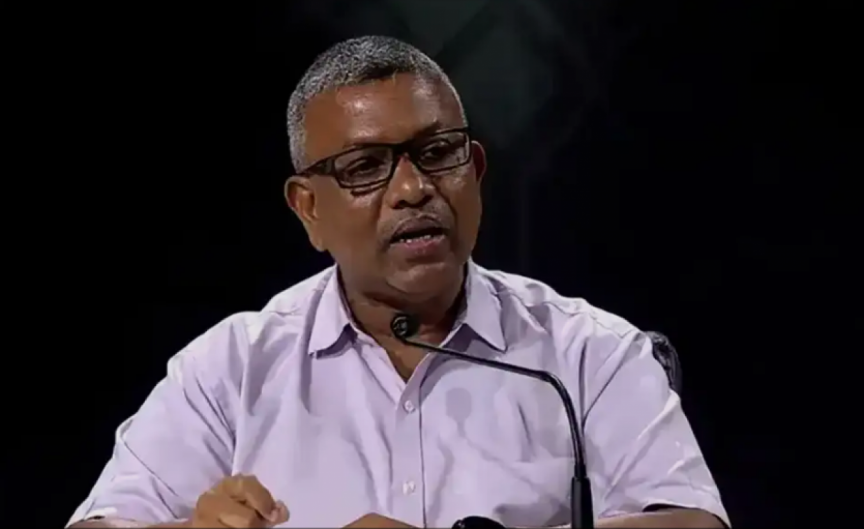
Former minister Ahmed Mohamed: Fitch rating upgrade is welcome news, but economic crisis hasn’t been fully solved yet. (Photo/Raajje MV)
While Fitch’s recent upgrade of the Maldives’ sovereign credit rating marks a positive development, former minister and economic analyst Ahmed Mohamed (AM) has stressed that avoiding a crisis should not be mistaken for solving it.
Fitch Ratings, one of the world’s leading credit rating agencies, upgraded the Maldives’ sovereign credit rating on June 3. The agency raised the rating from 'CC' to 'CCC-', representing an improvement after the country had remained at the 'CC' level since August 2024. Fitch had previously lowered the rating amid growing debt obligations and concerns over the Maldives’ ability to meet a USD 524.68 million Sukuk repayment.
Although the 'CCC-' rating remains within speculative or "junk" territory, Fitch stated that the risk of default has eased following the successful repayment of the Sukuk in April. The agency also expects foreign exchange inflows to improve as a result of ongoing fiscal reforms aimed at increasing government revenue, along with new regulations requiring the mandatory conversion of foreign currency earnings from the tourism sector.
In a post shared on X, Ahmed Mohamed said that while the immediate threat of default has diminished following the Sukuk repayment, substantial economic challenges continue to persist. Referring to Fitch’s assessment, he noted that the Maldives’ public debt-to-GDP ratio is expected to increase to 119.2 percent, while foreign reserves remain at critically low levels, insufficient to cover even a single month of imports.
The Fitch upgrade is welcome news.
— Ahmed Mohamed (AM) (@ahmedMDV) June 5, 2026
But avoiding a crisis and solving a crisis are not the same thing.
The immediate risk of default has eased following the repayment of the USD 500 million sukuk. That is positive. The Maldives has moved away from the edge of the cliff.
At the…
He further underscored that with a fiscal deficit of 14.6 percent and a current account deficit of 17.5 percent, the country still faces significant economic pressures. According to Ahmed, the key challenge extends beyond avoiding a default this year and lies in using the current opportunity to place the nation’s finances on a sustainable footing.
"The real test is not whether the country avoided default this year. The real test is whether this breathing space is used to put the public finances on a sustainable path," he stressed.
While some financial experts view the easing of immediate financial pressures as an opportunity to advance economic reforms, opposition figures have offered a different interpretation. They contend that the rating upgrade does not signify a fundamental strengthening of the country's economic position.
Echoing this view, former President Abdulla Yameen Abdul Gayoom recently stated that the improved credit rating was not driven by positive changes in economic stature. He argued that Fitch’s decision merely reflects the country's ability to meet its immediate debt obligations, providing only a temporary reprieve from default concerns.