date_range
Thursday 17 Sep 2026


 LOCAL EDITION
close
 LOCAL EDITION


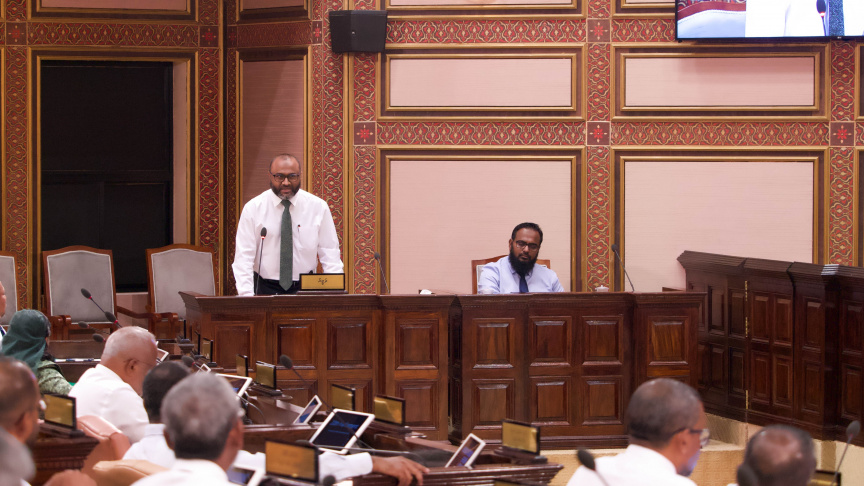
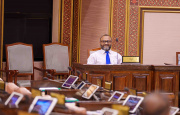
Islamic Minister Dr. Shaheem Ali Saeed answers questions at the Parliament on April 22, 2026. (Photo/People's Majlis)
Islamic Minister Dr. Mohamed Shaheem Ali Saeed, on Wednesday, said prolonged waitlists for Hajj stalling thousands of individuals from embarking on the pilgrimage is not a challenge unique to the Maldives, but rather a global issue affecting many nations.
Responding to a question by South Maafannu MP Abdulla Rifau during Wednesday’s parliamentary sitting, the Minister noted that Hajj waitlists are extremely long across all countries. He cited the three-year suspension of Hajj operations due to the COVID-19 pandemic as the primary factor behind the substantial increase in the Maldives' waitlist.
"The issue of the lengthy Hajj queue is not exclusive to the Maldives; it is a global phenomenon. In the Maldivian context, typically at least a thousand people apply to go to Hajj annually," Minister Shaheem explained.
The Minister detailed that approximately 3,000 individuals were stalled on the waitlist due to the pandemic. Moreover, he noted that when Hajj was resumed after the three-year suspension, only around 400 slots were initially allocated, further exacerbating the backlog.
Furthermore, the Minister underscored that Hajj administration in the Maldives is now managed through a structured system, which includes arrangements whereby parents, children, and employees of state institutions are able to contribute a portion of their salaries towards Hajj payment. He added that the inclusion of these groups in the queue has naturally contributed to the expansion of the waitlist.
The Minister noted that, following consultations with the Cabinet, the President has decided to allocate a designated percentage of slots to individuals over the age of 65, prioritizing elderly citizens who were already on the waitlist prior to the pandemic.
Despite these measures, the Maldives Hajj Corporation estimates that individuals currently making payments may only be able to perform Hajj by 2040, approximately 14 years from now.
According to the Corporation, this situation persists as the number of applicants continues to increase while the annual Hajj quota allocated to the Maldives remains unchanged.
The Saudi authorities currently allocate an annual quota of 1,000 pilgrims to the Maldives. Of this allocation, 850 slots are designated for individuals on the waitlist, 100 slots are reserved for assistants, including medical staff and cooks, and 50 slots are allocated to individuals from the poverty registry who are state-sponsored—a policy introduced by the current administration under an electoral pledge of President Dr. Mohamed Muizzu.
While the Islamic Ministry in various administrations have made repeated efforts to secure an increase in the Hajj quota, no significant progress has yet been achieved in this regard.