date_range
Friday 28 Aug 2026


 LOCAL EDITION
close
 LOCAL EDITION


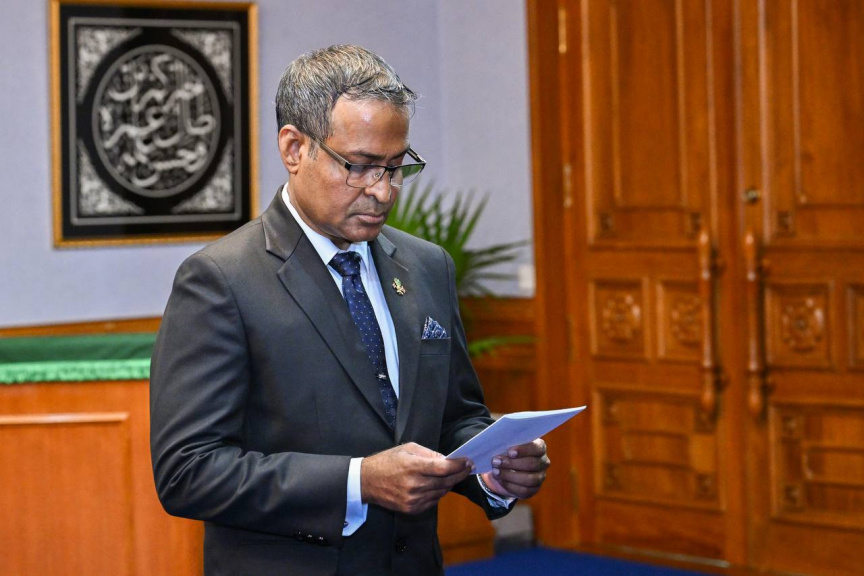
Chief Justice Abdul Ghani Mohamed: The Supreme Court has Court scheduled hearing in anti-defection case after year-long stall. (Photo/President's Office)
More than a year after it was filed, the Supreme Court has scheduled a hearing in a case challenging the controversial constitutional amendment which stipulates lawmakers will lose their seats if they switch political parties or is expelled from their party.
The constitutional amendment in question was submitted, passed and ratified in quick succession on November 20, 2024. In an unprecedented legislative process, the bill was debated, reviewed at committee stage, passed on the floor, and ratified by President Dr. Mohamed Muizzu all within the same day. The controversial amendment added three more circumstances where parliamentarians will lose their seat:
Former Kendhoo MP Ali Hussain, an attorney-at-law, filed a case with the Supreme Court seeking to nullify the anti-defection clauses on November 24, 2024.
Supreme Court has scheduled the hearing in the case for 10:30am next Tuesday. The case is being heard by the top court’s full bench comprising of Chief Justice Abdul Ghani Mohamed, Justice Aishath Shujoon Mohamed, Justice Ali Rasheed Hussain, Justice Dr. Mohamed Ibrahim, Justice Hussain Shaheed, Justice Abdulla Hameed, and Justice Mohamed Saleem.
In previous statements to Sun, Ali Hussain argued that the amendment cannot be applied retrospectively to sitting members of parliament. He further contended that, given the Maldivian public has chosen a presidential system of governance through a national referendum, such an amendment warrants careful examination, as anti-defection laws are not typically characteristic of presidential systems.
The most recent hearing in the case was held on February 17 of last year. The Court ruled—over the objection of the Attorney General—that it has the jurisdiction to hear the case, and scheduled a further hearing for February 26. However, shortly before the hearing was due to begin, the Judicial Service Commission (JSC) suspended three Supreme Court justices, resulting in its cancellation.
The day prior to the scheduled hearing, the PNC-dominated Majlis passed a bill to reduce the number of Supreme Court justices.
On February 26, 2025, then-Supreme Court justices Dr. Azmiralda Zahir, Mahaz Ali Zahir and Husnu Al-Suood were suspended by JSC, citing an ongoing criminal investigation against them by ACC. Suood resigned from the top court in protest of JSC’s decision, and the commission later opened misconduct cases against Azmiralda and Mahaz, accusing them of conspiring to influence the Criminal Court. Azmiralda and Mahaz - both of whom claim that the allegations against them are baseless and that the investigations by the JSC were tainted by the denial of due process to them - were dismissed by the Parliament with majority votes of 68-11 on May 14. All justices had accused the government of attempting to influence the attempting influence the top court.
Investigations reportedly initiated by the Anti-Corruption Commission (ACC) have not yielded any publicly known progress to date.
Later on, in July of last year, then-Chief Justice Ahmed Muthasim Adnan retired. Following his departure, the current administration appointed four new justices to the Supreme Court, as a major constitutional case remained pending before it.
The bill to reduce the number of Supreme Court justices has remained stalled in the Parliament as well.
The amendment has attracted widespread criticism, with many arguing that lawmakers losing their seats upon leaving or being expelled from their party fundamentally undermines their independence as elected representatives. The prolonged delay in Supreme Court case has further intensified criticism.