date_range
Saturday 22 Aug 2026


 LOCAL EDITION
close
 LOCAL EDITION


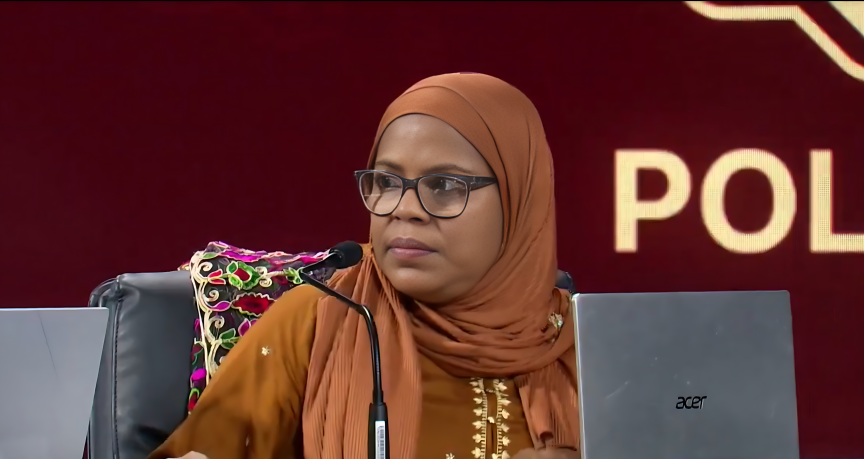
Former Attorney General Fathimath Dhiyana Saeed at the “Siyaasathu Haassa”, a forum organised by Policy MV on the proposal to merge the two main elections, March 26, 2026. (Photo/PSM)
Former Attorney General Fathimath Dhiyana Saeed said on Thursday that giving the ruling party a clear majority in parliament limits the public’s ability to hold the government accountable. She argued that holding the presidential and parliamentary elections on the same day would help produce a more balanced legislature.
Speaking at “Siyaasathu Haassa”, a forum organised by Policy MV on the proposal to merge the two main elections, Dhiyana said several former presidents and former attorneys general had supported the idea. She noted that former President Ibrahim Mohamed Solih backed holding presidential, council and parliamentary elections together in 2020, while former President Mohamed Nasheed voiced support for merging the two major elections last month.
Dhiyana said this support stemmed from the constitutional advantages of synchronising the elections.
One key benefit, she said, is that electing the president and parliament on the same day gives voters the chance to choose a legislature capable of checking the executive, as envisioned by the Constitution.
She argued that when elections are held months apart, the separation of powers becomes distorted. After a presidential election, she said, the public becomes more vulnerable to influence as the newly elected president begins exercising the powers of government while parliamentary candidates are still campaigning.
“Holding the two elections together creates the possibility of electing a separate, independent parliament,” she said.
Dhiyana said the Maldives’ experience shows how a dominant ruling‑party majority has weakened institutional checks. She noted that the Supreme Court bench has been changed five times and the Constitution amended seven times in just 18 years, developments she described as signs of an “unimpressive” constitutional journey.
She said the current electoral structure has repeatedly produced parliaments unable to hold the government accountable, and that synchronising the elections offers a chance to correct this.
“The opportunity to elect a parliament that can hold the government accountable is lost when the elections are separated,” she said.
Dhiyana added that the proposed change is not about reducing public access to leaders, but about ensuring the system produces a legislature strong enough to perform its constitutional role.