date_range
Friday 28 Aug 2026


 LOCAL EDITION
close
 LOCAL EDITION


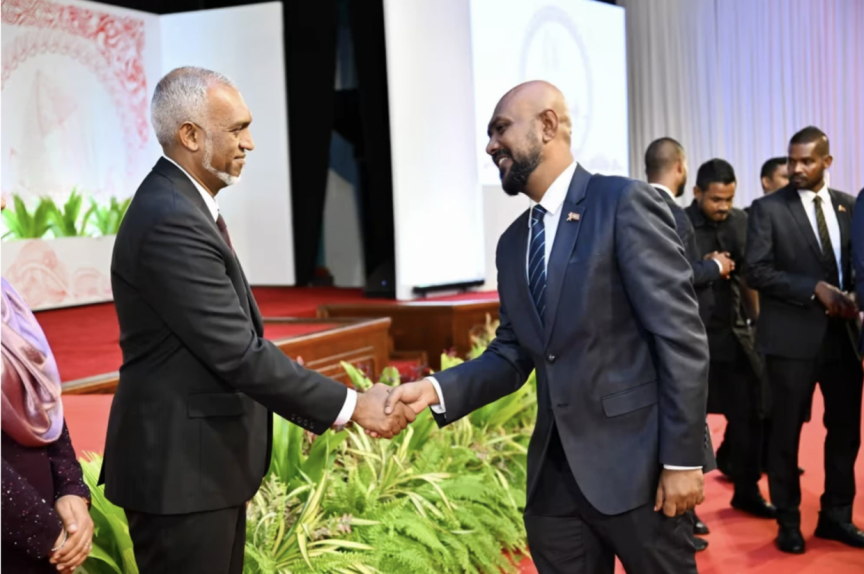
President Dr Mohamed Muizzu (R) shakes hands with the President of the Anti Corruption Commission of Maldives, Adam Shamil. (Photo/President's Office)
The Maldives’ Corruption Perceptions Index (CPI) remains low, with the country assigned a score of just 39 out of 100 in the 2025 review, something Transparency Maldives warns indicates limited progress in addressing systemic corruption.
The Maldives’ CPI scores have remained consistently low over the past five years, ranging between 38 and 43.
The country scored 39 out of 100 on the 2025 CPI released by Transparency International on Tuesday, ranking 91 out of 182 countries. It is just one score higher than the previous year, when the Maldives scored 38.
In a statement commenting on the new score, Transparency Maldives said stagnant score reflects ongoing governance challenges, including the centralization of executive power, shrinking civic space, and weakened independence of oversight institutions.
“From politicized appointments to opaque decision-making in state-owned enterprises, systemic vulnerabilities continue to undermine public trust and accountability,” warned the rights watchdog.
HEIGHTENED RISK OF STATE CAPTURE
Transparency Maldives said that one of the key areas of concern includes recent constitutional and legislative changes, that the group warns have significantly centralized authority within the executive, heightening the risk of state capture.
The group highlighted on the rushed enacted anti-defection constitutional amendments in 2024, which it warned have weakened democratic checks and balances and constrained citizen participation in decision-making.
“Parallel changes affecting the judiciary, including amendments to the Judicature Act and the suspension of Supreme Court justices, have further undermined the independence of the courts, creating avenues for executive influence over judicial processes,” warned the group.
Transparency Maldives also expressed concern over amendments to decentralization-related laws, that have transferred key administrative and decision-making powers from local councils to central authorities, further eroding local autonomy, limiting community oversight, and weakening participatory governance.
“Similarly, changes to the Anti-Corruption Commission Act and the Elections Commission Act allow the President to appoint the President and Vice President of both commissions, politicizing key oversight bodies and undermining institutional impartiality,” said the group. “Reduced independence of oversight institutions, including those responsible for anti-corruption and elections, raises the risk of state capture, diminishes transparency and erodes public trust in the government and key state institutions.”
SHRINKING CIVIC SPACE AND THREATS TO MEDIA FREEDOM
Another key concern raised by Transparency Maldives is the shrinking of civic space and threats to media freedom, especially with the enactment of the Maldives Media and Broadcasting Regulation in September 2025, replacing previous media oversight bodies with a new commission comprising seven members, three of whom are directly appointed by the President of Maldives.
“This undermines the independence and impartiality of the regulatory body, creating avenues for political influence over media oversight,” said the group. “By centralizing authority and limiting the autonomy of media institutions, the law further erodes democratic governance and constrains the space for accountability, transparency, and meaningful citizen participation.”
Transparency Maldives also expressed concern that fast-tracked processes such as the public referendum vote that took place to decide the jurisdictional composition of Addu City Council, also demonstrated a lack of meaningful public consultation.
“These measures threaten transparency, reduce citizen engagement, and undermine accountability mechanisms crucial for limiting corruption,” warned the group.
WEAK GOEVRNANCE AFFECTING ENVIRONMENTAL REGULATIONS AND ECONOMIC PROGRESS
Transparency Maldives warned that weak governance has affected both environmental regulation and economic progress, creating substantial risks of potential corruption.
This includes the August 2025 decision to dissolve the Environmental Protection Agency and restructure it as the Environmental Regulatory Authority, placing it directly under the merged Ministry of Tourism and Environment, as well as an amendment to the Environmental Impact Assessment (EIA) Regulation that allows the Cabinet to fast-track projects deemed of “special importance,” bypassing the EIA processes and undermining established safeguards designed to ensure transparency, accountability, and evidence‑based decision‑making.
The group also expressed concern over governance gaps in management of State-Owned Enterprises and large-scale development projects.
“Weak oversight, opaque procurement and recruitment practices, and insufficient institutional checks foster mismanagement of resources, distort resource allocation, and open avenues for corrupt practices,” warned the group.
CULTURE OF IMPUNITY
Transparency Maldives warned that persistent challenges in enforcing anti-corruption measures and ensuring accountability continue to undermine democratic governance in the Maldives.
“Weak oversight, limited transparency, and politically influenced decision-making create an environment where misconduct can go unchecked, and public officials may act with impunity,” said the group.
“Failure to strengthen anti-corruption related legislative frameworks, low conviction rate for perpetrators of corruption and ineffective implementation of legal protections, such as those for whistleblowers, further discourages reporting of corruption and abuse of power.”
Transparency Maldives called on the government to:
Transparency Maldives stressed the need for urgent reforms to restore institutional integrity and protect the fundamental freedoms necessary to tackle corruption effectively.